HR round, offer, BGV
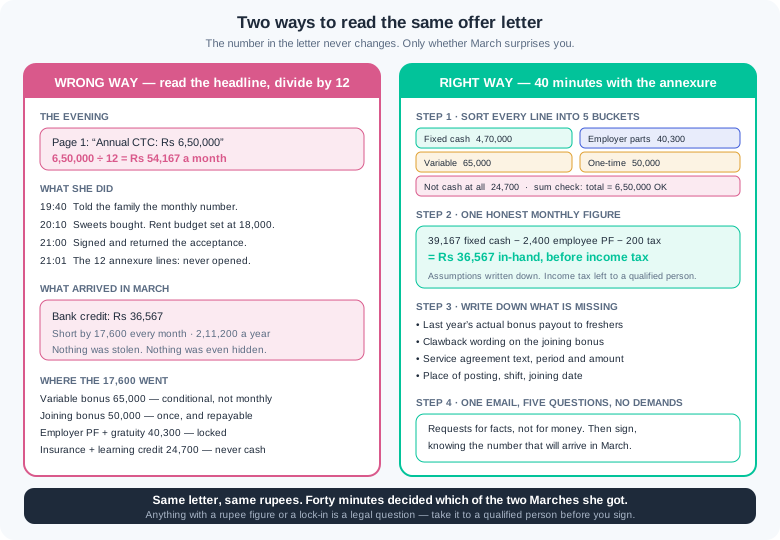
Pallavi opened her first offer letter in Nellore. The number on top said six lakh fifty thousand a year. Her mother divided it by twelve and got fifty four thousand a month. The family bought sweets that night. In March the first salary landed in her bank account: thirty six thousand five hundred. Nobody had cheated her. She had read one number and skipped the twelve lines below it. Those twelve lines were the real offer, and she had signed them.
- This is the round where a real number and a real contract reach your hands. One careful hour here is worth more than a month of extra practice problems.
- The offer letter is the first document you sign as a working adult. What you skip today, you live with for two years.
- Background checks confirm what you wrote down. Every honest line you kept across this programme now pays you back, and any line you stretched now costs you.
The HR round is not a formality. It is a filter, and it screens four things: fit, stability, expectations and red flags. Fit asks whether you will work well with this team. Stability asks whether you will still be here in a year. Expectations asks whether your salary hope and the company's band can meet at all.
Red flags are the quiet fourth screen. A story that changes between rounds is a red flag. So is a candidate who speaks badly about a college or a past team. So is a person who cannot say why this company, out of the ten they applied to.
Eight questions come back again and again. The first four are about you and the firm: tell me about yourself; why this company; where do you see yourself; why should we hire you. The next four probe risk: what is your weakness; why this gap or backlog; are you interviewing elsewhere; and what are your expectations. None of them wants a memorised speech.
Two of them are hard for this audience. A backlog, a gap year or a low CGPA feels like a wound you must explain for five minutes. Do the opposite. State the fact in one line, say what you did about it, and stop. Then move to the evidence you own now, which is the portfolio you built in module 6.8.
Now the money. CTC — cost to company, the full amount a firm counts as spending on you in a year — is the headline on page one. It is not a salary. It is a total, and it holds parts that never reach your bank account. Read the annexure line by line before you read that headline again.
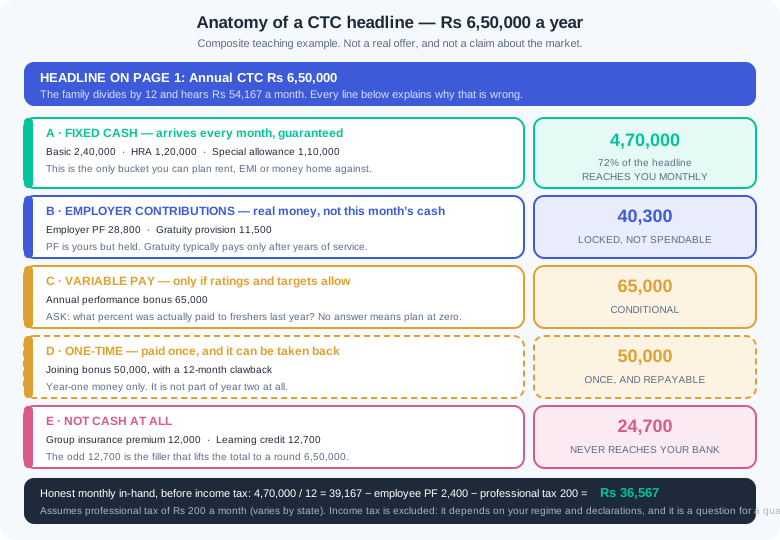
Every line in that annexure falls into one of four buckets. Fixed cash arrives every month and is the only part you can plan a life around. Variable pay — a share of the total paid only when targets or ratings allow — may arrive in part, or not at all. One-time money, such as a joining bonus, is paid once and often carries a clawback rule. Non-cash items, such as an insurance premium, carry real value but never land in your account.
Gross pay is what the fixed cash adds up to before deductions. In-hand salary — the amount that actually reaches your bank account each month — is smaller. Your own provident fund share comes out, and so does professional tax in most states. Income tax comes out too, and how much depends on the regime you pick and what you declare. That last part is a question for a qualified person, so ask one before you plan around a number.
Here is the contrast this module exists for. The wrong way is Pallavi's evening: read the headline, divide by twelve, tell the family, sign. The right way takes forty minutes: sort every line into the four buckets, work out an honest monthly figure, write down what is missing, and ask before you sign. The number in the letter does not change. What changes is whether March surprises you.
Four kinds of clause meet most freshers, and none of them is decoration. A service agreement — a promise to stay for a fixed period, with an amount stated as payable if you leave early — is common in mass campus hiring. A notice period says how much warning you must give before you leave. Probation is a starting stretch, often three to six months, in which either side can end things faster. Many offers also assign to the company any work you create in the role, and some add a non-compete clause.
Whether a particular clause holds up is a legal question, and this module does not answer legal questions. We can tell you what such a clause usually says and what it usually costs in practice. We cannot tell you whether your bond can be enforced, and nobody should tell you that from a slide. Before you sign anything carrying a rupee figure or a lock-in period, show it to a qualified person. A senior in a hostel room is not that person.
Before signing, check the plain facts against what you were told. Does the role title match the daily work described in the interview, the way module 6.1 taught you to read a job advert? Is the location named, and the shift? Is the joining date written down, or only promised? A warm promise from a friendly manager is worth nothing once that manager changes teams.
Now negotiation, honestly. A fresher's leverage is usually small, and in mass campus hiring it is often zero, because the band is fixed for the whole batch. Three moves still exist. A polite ask costs nothing and sometimes moves a number a little. A second written offer is the only real lever most freshers ever hold.
When cash is fixed, other things may not be. Location, team, joining date and the start of a training track are all worth asking about. Ask once, in writing, and be pleasant about it. If the answer is that the band is set, believe it and accept well. Pushing a fixed number a fourth time spends goodwill you will need on day one.
Background verification — the check a company runs on your documents and history after the offer — is the last gate. It usually covers education and past employment, and sometimes address or a criminal record check. An outside agency does it, and it calls your college and your past employers. A small lie survives an interview easily and dies here, often months after you joined. Offers get withdrawn over an internship written as six months when the record says three.
Genuine problems are different from lies, and you handle them by speaking first. A missing document, a name spelt two ways across certificates, a college that is slow to reply: say it before the agency finds it. Send the correct dates and whatever paperwork you do have. A gap you raised is an administrative task, while the same gap found by a verifier becomes a question about your honesty. This is module 6.6's rule about limits, now with paperwork attached.
You may hold two offers at once, and that is not a crime. Tell each company the truth about your timeline, and ask for a decision date you can meet. When you decline, decline in writing, in two lines, and thank them. Never stop replying, because the recruiter you ignore today reads your name again in three years. India's AI hiring circles are small.
The weeks between signing and joining are yours, and most students waste them. Keep your project alive, so you can run it on day one instead of repairing it. Read whatever the company publishes about the product you will touch. Put your documents in one folder, scanned and named properly, before anybody asks. Then plan the first ninety days: learn the map, ask questions in writing, and ship one small thing a teammate uses.
One salary fact in this programme survived hard checking, and module 6.1 holds it. At one large IT services firm, in one financial year, the fresher pay ladder ran at roughly 7, 11, 16 and 21 lakh rupees. The mass entry tier sat near 3.6 to 4 lakh, and an internal AI skills test opened the top rung. Check it yourself in that firm's quarterly results and annual report.
That is one company and one year, and it does not describe a market. Do not repeat it as what freshers earn. Every other salary number you meet this season needs the same question. Where did it come from, and can you read the source yourself? Apply that test to this page as well.
Six worked artefacts, and no code to run. The student in them is Pallavi from the scene, redoing the evening she lost. Every rupee figure below comes from a composite offer we wrote for teaching; none of it is a real letter from a real company, and none of it is a claim about the market.
Piece 1 — one CTC breakup, pulled apart line by line. Same offer she signed, now read properly:
# PIECE 1 - OFFER A, PULLED APART. Composite example, not a real letter.

HEADLINE ON PAGE 1:  "Annual CTC: Rs 6,50,000"
Naive monthly reading: 6,50,000 / 12 = Rs 54,167   <- what the family hears

THE ANNEXURE, LINE BY LINE, SORTED BY WHAT IT REALLY IS
--------------------------------------------------------------------
A. FIXED CASH (arrives every month, guaranteed)
   Basic salary                                 2,40,000
   House rent allowance (HRA)                   1,20,000
   Special allowance                            1,10,000
                                     A total =  4,70,000

B. EMPLOYER CONTRIBUTIONS (real money, not this month's cash)
   Employer PF contribution (12% of basic)         28,800
   Gratuity provision                              11,500
                                     B total =     40,300
   -> PF is yours, held until you withdraw it. Gratuity is a
      provision, and it typically pays out only after several years
      of service. Both sit inside CTC. Neither is monthly cash.

C. VARIABLE (paid only if ratings and targets allow)
   Performance bonus, annual                       65,000
                                     C total =     65,000
   -> ASK: what percent of this was actually paid to freshers last
      year, on average? If nobody will answer, plan as if it is zero.

D. ONE-TIME (paid once, and it can be taken back)
   Joining bonus                                   50,000
                                     D total =     50,000
   -> Clawback: resign inside 12 months and you repay it. This is
      year-one money. It is not part of year two at all.

E. NOT CASH AT ALL
   Group health insurance premium                  12,000
   Learning and certification credit                12,700
                                     E total =     24,700
   -> The insurance has real value and never reaches your account.
      The 12,700 is an odd number for a reason: it is the filler
      that lifts the total to a round 6,50,000.

CHECK:  4,70,000 + 40,300 + 65,000 + 50,000 + 24,700 = 6,50,000  OK

HONEST MONTHLY IN-HAND ESTIMATE (before income tax)
   Fixed cash per month        4,70,000 / 12        =  39,167
   less employee PF            12% of basic 20,000  =  -2,400
   less professional tax       assumed Rs 200/month =    -200
                                          in-hand   =  36,567

   ASSUMPTIONS, STATED PLAINLY:
   (1) Professional tax at Rs 200 per month. The rate and the slab
       depend on your state, so check yours.
   (2) INCOME TAX IS NOT DEDUCTED HERE. What you pay depends on the
       regime you choose and what you declare. That is a question for
       a qualified person, not for this page and not for a senior.
   (3) The variable and the joining bonus are deliberately excluded.
       Never spread conditional money across twelve months.

THE GAP THAT MATTERS
   Family's number   54,167 per month
   Honest estimate   36,567 per month
   Difference        17,600 per month, and every rupee of it is
                     explained by a line she did not read.
Read the check line first, because a breakup that does not add up to the headline is a breakup you have copied wrongly. Bucket A is the only part you can plan rent around, and it is 72% of the headline here, which is on the healthier side. Bucket B is real money that is not yours this month, so counting it as salary is the most common mistake in this room. Buckets C and D are conditional, and the honest treatment is to plan at zero and be pleased if they arrive. The last block is the whole module in three lines: the difference between 54,167 and 36,567 is not a scam, it is a reading failure.
Piece 2 — the eight HR questions, with the two hardest answered twice. The shape first, then the ones that decide rounds:
# PIECE 2 - THE EIGHT QUESTIONS. Shape first, then the two hard ones.

WHAT EACH QUESTION IS ACTUALLY SCREENING
 1 Tell me about yourself      -> can you structure 90 seconds?
 2 Why this company            -> did you research, or apply blind?
 3 Where in three years        -> stability. Will you leave in month 5?
 4 Why should we hire you      -> evidence, not adjectives.
 5 Your weakness               -> self-knowledge, and is it fixable?
 6 Why this gap / backlog      -> honesty and recovery, not the gap.
 7 Interviewing elsewhere      -> honesty, and how fast they must move.
 8 Your expectations           -> can our band and your hope meet?

SHAPE FOR 1 TO 5 (one line each, then your own evidence)
 1 present -> path -> what you built -> why this role. 90 seconds.
 2 name the team, the product, and where you read about it.
 3 "deeper in <this kind of work>", named. Not "a manager".
 4 one project, one number, one decision you can defend.
 5 a real one you are working on, with the fix you already run.

--- HARD ONE (A): THE BACKLOG AND THE LOW CGPA ---------------------
Q: "You have a backlog in semester six and your CGPA is 6.4. Explain."

BAD ANSWER (the five-minute wound)
 "Sir, actually that semester was very difficult because my father
  was unwell and I travelled home every weekend, and the faculty for
  that subject changed twice, and the paper was out of syllabus, and
  many students failed, actually 40% of our class failed, and I was
  also handling the college fest, so my attendance also suffered..."
 WHAT THE PANEL HEARS: this defence has been practised. Every extra
 sentence adds one more person to blame. Four minutes spent on one
 bad semester is four minutes not spent on the churn model. The
 backlog was one fact; the speech turned it into a pattern.

GOOD ANSWER (fact -> action -> pivot, about 25 seconds)
 "Yes. One backlog in semester six, and I cleared it in the next
  attempt. My CGPA is 6.4, and marks are honestly not my strongest
  side. What I can show you is what I built after that: a churn model
  on 500 customers, 0.824 against a 0.688 do-nothing baseline, served
  behind an API at p95 19 ms, with a drift check that caught a PSI of
  0.31. The repo runs from the README in five minutes, and I am happy
  to walk you through any decision inside it."
 WHY IT WORKS: the fact is stated first and owned, so nobody has to
 dig for it. No blame, no story, no excuse. Then the evidence from
 module 6.8 arrives, and the room now has something better to ask
 about. RULE: under 30 seconds, and never explain the same thing twice.

--- HARD ONE (B): "ARE YOU INTERVIEWING ELSEWHERE?" ----------------
BAD ANSWER 1 (the lie)
 "No sir, only your company."
 -> Nearly always false, and it sounds false. If a second offer
 arrives next week you must either hide it or contradict yourself.
 You have also thrown away the only real lever a fresher holds.

BAD ANSWER 2 (the bluff)
 "Yes, I have three offers at 12 LPA and I am deciding between them."
 -> If they ask to see one letter, the bluff ends there. Recruiters
 in the same city talk to each other. An invented offer is the
 fastest way to lose the one that was real.

GOOD ANSWER (true, short, and useful to them)
 "Yes, I am in process with two other companies. One is at the final
  round and I expect to hear by the 20th. I would rather make one
  decision than several, so if your timeline is near that, it helps
  me. This is the role I have prepared most for, and I can tell you
  exactly why."
 WHY IT WORKS: it is true, it hands them a date they can act on, and
 it signals demand without a number you cannot prove. Name a figure
 only when you hold the letter and can show it.
 IF YOU HAVE NOTHING ELSE: "No, this is the only process I am in
 right now." That is also a fine answer. Honest and short beats
 clever, every single time.
Notice what the two good answers share: they are short, they are checkable, and they end by handing the room something better to discuss. The bad backlog answer fails on length before it fails on content, because a four-minute defence tells the panel the fact still controls you. The bad "elsewhere" answers fail in the opposite direction, since one hides information the panel will get anyway and the other invents information they can ask to see. Question 8, your expectations, has one honest fresher answer: name the band you have seen for this role and this city, say you are flexible on structure, and ask what the band for this batch is. Never invent a number to sound expensive, because the person across the table knows the band and you do not.
Piece 3 — a pre-signing checklist, run against the real letter. Twelve checks, and what each one found:
# PIECE 3 - PRE-SIGNING CHECKLIST, RUN ON OFFER A. Composite letter.

WHAT THE LETTER SAYS (all of page 1)
 "We are pleased to offer you the position of AI Engineer - Trainee
  at an annual CTC of Rs 6,50,000. Your date of joining will be
  communicated separately. Place of posting: as per business
  requirement. You will be on probation for six months. You are
  required to execute a service agreement for 24 months. Notice
  period: 60 days. Kindly confirm acceptance within 3 days."

CHECKLIST                                RESULT ON THIS LETTER
 1 Role title vs the daily work          GAP - title says AI Engineer;
   described in the interview              the interview described 60%
   (module 6.1's rule)                     data labelling. Not written.
 2 Location named                        GAP - "as per business
                                           requirement" can mean any
                                           city. The verbal promise of
                                           Hyderabad is not in here.
 3 Shift named                           GAP - silent. Ask about a
                                           rotational or night shift,
                                           and any shift allowance.
 4 Joining date written                  GAP - "communicated
                                           separately". You cannot
                                           plan a life around this.
 5 Full CTC annexure attached            PRESENT - see piece 1.
 6 Variable pay: how measured, and       GAP - the amount is given,
   last year's actual payout               the rule is not.
 7 Joining bonus clawback terms          PRESENT - 12 months, full
                                           repayment. Read it twice.
 8 Probation: what changes during it     PARTIAL - 6 months stated;
   and what happens at the end             what confirmation depends
                                           on is not stated.
 9 Service agreement: period, amount,    PARTIAL - 24 months stated,
   and what triggers it                    amount NOT stated. Ask for
                                           the text BEFORE accepting.
10 Notice period, both directions        PARTIAL - 60 days from you.
                                           Nothing about the company.
11 Ownership and confidentiality         NOT SEEN - usually inside the
   clauses                                 full agreement, not the
                                           offer letter. Ask for it.
12 Everything promised verbally is       FAIL - three promises exist
   somewhere in the letter                 only in a conversation.

THE THREE-DAY WINDOW: a short acceptance deadline is normal, and it
is also pressure. Asking for the service agreement text and a written
location line is a reasonable request, not a red flag. If a company
treats a polite request for facts as a problem, you have learnt
something useful about that company.

WHAT SHE SENDS BACK (one email, five questions, no demands)
 1 Could you share the service agreement text, including the amount
   and what triggers it? I would like to read it before I accept.
 2 Could the letter name the place of posting, or the possible cities?
 3 What is the expected joining month?
 4 For the performance bonus: how is it measured, and what was the
   average payout to freshers last year?
 5 Is there a rotational or night shift in this role?

NOTE: not one of these is a negotiation. They are requests for facts
that belong on paper anyway. Whether a stated bond amount can be
enforced against you is a legal question - take the agreement text to
a qualified person before you sign it, not after.
Count the results: four outright gaps, four partials, and only two clean passes on a letter that looked complete. Check 12 is the one that catches people, because three of the things she was told in the room appear nowhere on the page. Checks 9 and 11 matter most in rupee terms, and both point at a document she has not been shown yet, which is why "send me the agreement text" is the single most useful email in this module. The five questions are deliberately flat and factual, and none of them asks for more money. Asking for facts before you sign is normal professional behaviour; discovering them in month three is not.
Piece 4 — two negotiations, one that moves and one that should not. Same student, two different situations:
# PIECE 4 - TWO NEGOTIATIONS. One moves. One should not be pushed.

--- CASE 1: A SECOND WRITTEN OFFER EXISTS (leverage is real) -------
Situation: Offer A, 6,50,000 CTC, acceptance due in 3 days. Offer B
in hand and in writing: 8,00,000 CTC, but only 3,96,000 of it is
fixed cash. She prefers Company A's team and city.

WHAT SHE DOES NOT SAY
 "I have a better offer, match it or I walk."
 -> Company A can verify nothing, and that sentence invites the
 shortest possible reply: "then you should take it".

WHAT SHE WRITES (one email, six lines)
 "Thank you for the offer. I want to join, and Company A is my first
  choice for the team and the city.
  I do have a second written offer with a higher fixed component. I
  am not trying to create a bidding situation and I will not play one
  company against another.
  If there is any room on the fixed portion, that would make the
  decision straightforward for me. If the band is set for this batch,
  I understand completely, and I would still like to accept.
  Either way, I can confirm by Thursday."

WHAT CAME BACK
 "The fixed band is set for the fresher batch and I cannot change it.
  I can move the joining bonus from 50,000 to 75,000, and I can name
  Hyderabad as your place of posting in the letter."

READ THE RESULT HONESTLY
 Fixed cash: unchanged at 4,70,000. Monthly in-hand: unchanged at
 about 36,567. Nothing recurring moved at all.
 Gained: 25,000 one-time, still bound by the 12-month clawback, plus
 a WRITTEN location line, which was gap 2 in piece 3.
 The location line is worth more than the 25,000, because it turns a
 verbal promise into a term of the offer. That promise is exactly
 what fails in WR-173.
 WHY THE ASK WORKED: it named a preference, made no threat, and gave
 the recruiter an easy way to say no without losing her.

--- CASE 2: MASS CAMPUS DRIVE (leverage is zero) -------------------
Situation: a campus offer, one band for 300 students, letters issued
the same day to everyone. A senior tells him to "always negotiate".

WHAT HE ASKS ONCE (in person, 20 seconds)
 "Thank you. Is the package the same for the whole batch, or does it
  vary by role?"
ANSWER: "Same for the batch. There is a review after the training
 assessment."

THE RIGHT MOVE NOW: accept, warmly and quickly.
 Pushing here will not move a batch-wide band. It does two other
 things instead: it spends goodwill with the one person who will
 remember his name on day one, and in some campus processes it can
 put the offer itself at risk.
 The lever that does exist was named in the answer - the TRAINING
 ASSESSMENT. The honest reading of the Infosys ladder from module 6.1
 says the same thing: at that firm, in that year, a skills gate
 separated the tiers. No email separated them.

WHAT HE ASKS INSTEAD (non-cash, all reasonable)
 - Which location and which practice will I be assigned to?
 - When is the training assessment, and what does it cover?
 - Can I have the service agreement text now, not on joining day?
 None of these costs the company a rupee, and all three change his
 first year more than a 20,000 rupee request would have.
Case 1 is the only kind of leverage most freshers ever get, and notice how little cash it moved: the recurring number did not budge by one rupee. What actually improved was a term, and a term outlasts a bonus. Case 2 is the case students are worst at, because "always negotiate" is repeated by people who have never sat in a campus drive. The test for which case you are in is one question, asked once and politely: is this band fixed for the batch? When the answer is yes, accepting quickly and warmly is not weakness, it is reading the room correctly.
Piece 5 — one BGV discrepancy, handled two ways. Same student, same paperwork, two different months:
# PIECE 5 - BGV, HANDLED TWO WAYS. Same student, same paperwork.

WHAT A BGV AGENCY TYPICALLY CHECKS FOR A FRESHER
 EDUCATION   degree, college, roll number, year of passing, and
             whether the college confirms all of it
 EMPLOYMENT  every internship or job you listed: employer, dates,
             role. They contact the company, not your mentor.
 IDENTITY    name and date of birth, matched across documents
 ADDRESS     sometimes, by post or a field visit
 CRIMINAL    sometimes, depending on employer, sector and role
 NOTE: scope varies by company. Ask what yours covers, in writing.

--- THE DISCREPANCY -------------------------------------------------
Her resume says: "Data Analyst Intern, <startup>, Jun 2025 - Dec 2025
(6 months)".
The truth: the formal internship ran Jun to Aug 2025, three months.
She then kept working on the same project, unpaid and with no letter,
until December. She wrote "6 months" because it felt true to her.

--- PATH 1: SAY NOTHING AND HOPE -----------------------------------
 Month 0  Offer signed. BGV form filled in with the same 6 months.
 Month 1  Agency emails the startup's HR. Their record says 3 months.
 Month 2  Report returns marked DISCREPANCY - EMPLOYMENT DATES.
 Month 3  HR asks her to explain. Whatever she says now is heard as a
          defence, because the verifier found it first.
 OUTCOME  It varies by company, and that is the honest answer. Some
          accept a written explanation. Some treat any mismatch as a
          fixed rule and withdraw the offer, or end employment if she
          has already joined. Some record it internally, and that note
          travels with her inside that group.
 THE POINT: a three-month exaggeration, worth nothing at hiring time,
 has become a question about whether she can be trusted with customer
 data in a bank's pipeline. That is WR-174.

--- PATH 2: SPEAK FIRST (same facts, sent before the check) ---------
 Sent to the recruiter the day after signing, before BGV began:

 "Before the verification starts, I want to correct one line on my
  resume myself. I wrote 'Jun 2025 - Dec 2025 (6 months)' for the
  analyst internship. The formal internship was Jun to Aug 2025,
  three months, and I have the certificate for that. From September
  to December I continued on the same project without pay and without
  a letter, and I should have written it exactly that way. The startup
  will confirm three months. I have attached the certificate and my
  commit history for the later work. Sorry for the correction - I
  would rather you heard it from me."

 OUTCOME: an administrative note, not an integrity case. The recruiter
 updates the record. Verification then returns matching what she
 declared, because she declared what was true.
 WHY IT WORKS: the same fact moved from "found" to "disclosed". That
 one move is the entire difference, and it cost her one email.

RULE: if a line on your resume would need a paragraph of explanation
later, rewrite the line now. Module 6.6's limits-first habit, module
6.8's ten-minute rule, and this email are one rule at three stages.
The two paths carry identical facts and land in different worlds, which is the only lesson here. Path 1's damage is not the three months; it is the sequence, because a fact discovered by a verifier is read as a fact you hid. Path 2 costs one email and turns the same discrepancy into paperwork. Note the outcome line in path 1 refuses to promise you anything, since company policy varies and anyone who tells you "nothing ever happens" is guessing. If a document is genuinely delayed rather than wrong, the same move applies: say so early, in writing, with the date you expect it.
Piece 6 — the offer-in-hand period, and the gap before joining. What to do with the months nobody plans for:
# PIECE 6 - THE OFFER-IN-HAND PERIOD, AND THE GAP BEFORE JOINING.

--- DECLINING WITHOUT BURNING THE BRIDGE ---------------------------
BAD: stop replying. The recruiter chases twice, marks you as
 "non-responsive", and that note stays in their system. India's AI
 hiring circles are small, and the same recruiter changes companies
 every few years and takes her memory with her.

GOOD (two lines, sent the day you decide):
 "Thank you for the offer and for the time your team gave me. I have
  accepted another role that is closer to <specific reason>. I would
  be glad to stay in touch, and I hope our paths cross again."
 Send it as soon as you decide, not on your joining date. If you have
 already signed and must withdraw, say so as early as possible and in
 writing. A withdrawal three weeks out is a scheduling problem; one on
 joining morning is a story people repeat for years.

--- HOLDING TWO OFFERS HONESTLY ------------------------------------
 Ask each company for a decision date, and give them a real one back.
 Do not accept two offers "to be safe". Signing something you intend
 to break is a poor way to start a career, and a service agreement can
 carry a rupee figure attached to leaving.

--- THE GAP BETWEEN SIGNING AND JOINING (often 1 to 4 months) -------
 WEEK 1  Documents. Degree certificate, every semester marksheet,
         internship letters, PAN, Aadhaar, bank details, payslips if
         any. One folder, scanned, named "2026-06_marksheet_sem6.pdf"
         and not "IMG_2231.jpg". Chase your college NOW for anything
         missing, because colleges are slow and BGV waits for nobody.
 WEEK 2  Keep the project alive. Clone your own repo into a fresh
         folder and run it end to end. On day one you want to show it,
         not repair it.
 WEEK 3  Read what the company publishes: product pages, engineering
         blog, public API docs. Write down ten questions you will ask.
 WEEK 4  Revise the boring layer: git, SQL joins, one language well.
         That is what your first month will actually use.

--- THE FIRST 90 DAYS, ONE LINE EACH -------------------------------
 Day 1-30   Learn the map. Ask questions in writing, so the answers
            are reusable. Get their codebase running locally - the
            same clone test from module 4.1, on somebody else's repo.
 Day 31-60  Ship one small thing a teammate actually uses. Small and
            finished beats large and pending.
 Day 61-90  Write down what you were wrong about in month one, and
            what you would do differently. That note is the start of
            your next project defence, and of your next offer.
The decline note is two lines because two lines is all that is needed, and sending it costs you nothing you wanted to keep. The pre-joining weeks are where the students who arrive strong separate from the ones who arrive nervous, and week 1 is the one with a deadline attached, since a college transcript can take a month to arrive. Week 2 is module 4.1's clone test used as insurance, because a project that ran in March may not run in July. The first ninety days are outside this course, and they are also the point of it: the same habits that got you through the gate are the ones that keep you inside it.
Work in a folder called offer with four files: decode.md for the two offer breakups, hr-answers.md for your eight answers, checklist.md for the pre-signing run and your questions to HR, and bgv.md for your document pack and disclosures. Every rupee figure you write must be traceable to a line in a breakup, and every assumption must be written down beside it.
One rule for all three exercises: where something is a legal or tax question, write the words "legal question" or "tax question" and the name of the person you would ask. Do not answer it yourself, and do not let a senior answer it for you.
Decode two offers and find what is missing from both. Copy both offers below into decode.md, exactly as printed. Offer A, headline 6,50,000 CTC: basic 2,40,000; HRA 1,20,000; special allowance 1,10,000; employer PF 28,800; gratuity provision 11,500; annual performance bonus 65,000; joining bonus 50,000 with a 12-month clawback; group insurance premium 12,000; learning credit 12,700. Offer B, headline 8,00,000 CTC: basic 2,40,000; HRA 96,000; special allowance 60,000; employer PF 28,800; gratuity provision 11,500; variable pay 1,44,000 paid quarterly against targets; joining bonus 1,00,000 with a 24-month clawback; retention bonus 60,000 payable at 24 months; stated ESOP value 40,000 a year on a four-year vest with a one-year cliff; insurance premium 18,000; internet and device reimbursement 1,700 against bills. For each offer, sort every line into the five buckets from piece 1, add the buckets back up and confirm they reach the headline, then compute the monthly in-hand estimate before income tax using employee PF at 12% of basic and professional tax at 200 a month. Write the assumptions beside the figure. Then write, for each offer, the year-two cash if the variable pays 100% and if it pays 50%. Finish with a list of everything the breakup does not tell you, and turn that list into questions addressed to HR. Check: both bucket sums reach the headline exactly and you show the addition; Offer A's in-hand comes to about 36,567 a month and Offer B's to about 30,400 a month; you state in one sentence that the 8,00,000 offer pays roughly 6,167 a month less than the 6,50,000 one and name the reason; both year-two figures are computed at 100% and 50% variable with the arithmetic shown; your missing list includes at least the actual variable payout last year, the clawback wording, the ESOP strike price and exit route, and whether the reimbursement needs bills; and every question to HR is a request for a fact, not a request for money.
Write and record your answers to all eight HR questions. In hr-answers.md, write your own answer to each of the eight questions from piece 2. Then record yourself saying each one aloud, without reading, and note the time in seconds beside it. Now audit every answer against three tests. Length: question 6, about a gap, a backlog or a low CGPA, must finish in under 30 seconds, and no answer may run past 90 seconds. Honesty: mark any sentence you could not defend if the panel asked for proof, and delete it. Evidence: every one of the eight must end at something from your own portfolio, with a number in it. For question 7, write your true answer for the situation you are actually in, whether that is two live processes or none. For question 8, write the band you have seen for this role and city, name where you saw it, and write the question you will ask back. Check: eight written answers with a recorded time in seconds beside each; your gap or backlog answer is under 30 seconds and states the fact in its first sentence with no blame in it; no answer exceeds 90 seconds; at least six answers end on a named project number you can defend for ten minutes; your answer to question 7 is true and contains no invented offer or invented figure; your answer to question 8 names a source for the band and asks a question back; and you list every sentence you deleted for failing the honesty test, with the reason.
Run the pre-signing checklist, build the document pack, and write the two hard emails. In checklist.md, run all twelve checks from piece 3 against a real fresher offer letter you can get hold of, from a senior, a placement cell sample or a public template, with the company name removed. Mark each check PRESENT, PARTIAL, GAP or NOT SEEN, and quote the exact words from the letter that made you decide. For every clause carrying a rupee figure or a lock-in, write the words "legal question" and name who you would take it to. Then write the email that asks for the missing facts, with a maximum of five questions and no demands. In bgv.md, list every document a background verification would ask you for, mark which ones you hold today, and name the date by which you will get each missing one. Read your own resume line by line against those documents, and write down any line where the paper and the page do not match. For each mismatch, write the proactive disclosure email using piece 5's shape. Finish with a two-line decline note for an offer you would refuse. Check: twelve checks are marked with the exact quoted words that justify each mark, and at least four are GAP or PARTIAL; every rupee-figure clause and every lock-in clause is marked as a legal question with a named person to ask; your questions email holds five or fewer questions, all of them requests for facts; your document list covers education, employment, identity and address with a held-or-pending mark and a date for each pending item; every resume line that does not match a document has a disclosure email written in the fact-then-correction-then-proof shape; and your decline note is two lines, thanks the team, and contains no complaint.
Three offer-stage failures that cost freshers money, months or the job itself. Each has a War Room entry with the full diagnosis path:
- WR-172 — the CTC that shrank. A student accepted on a headline number, then found the monthly credit far below the figure his family had divided out, because variable, one-time and non-cash lines were never separated; the fix is the line-by-line decode from piece 1 and the five factual questions asked before accepting.
- WR-173 — the verbal promise that vanished. Role, city and team were promised in conversation, the letter said "as per business requirement", the friendly manager moved to another account, and nothing was owed; the fix is to get every promise written into the letter before you sign, and to treat a refusal to write it down as information.
- WR-174 — the BGV that caught a small lie. An internship written as six months was recorded as three by the employer, the discrepancy surfaced after joining, and it became an integrity case rather than a date correction; the fix is the honesty rule from modules 6.6 and 6.8 extended to documents, plus the proactive disclosure email from piece 5.
The HR round is a filter, and it screens fit, stability, expectations and red flags. CTC is a total, so sort every line into fixed cash, employer contributions, variable pay, one-time money and non-cash before you believe any monthly figure. Read the clauses on bond, notice period, probation and ownership, and take anything with a rupee figure to a qualified person. Ask politely, use a written competing offer if you hold one, negotiate the terms when the cash is fixed, and accept well when the band is truly set. Background verification checks what you wrote down, so the honesty you carried from your first command not found in module 0.1 to this offer letter is the thing that finally pays.
- IT services campus drives issue one band to a whole batch, with a service agreement and a training assessment attached. Students who read the agreement before joining day, and who prepare for that assessment, move tiers; students who negotiate by email do not.
- Bank and NBFC captive centres run the strictest checks a fresher will meet, because their own regulators check them. Education, employment and sometimes address checks are routine there, and a date that does not match is treated as a control failure.
- Product startups load more of the headline into variable pay, joining bonuses and share options. The same decode from this module is what tells you whether a bigger headline is actually more money in your bank account each month.
Answer these aloud before opening the gate assessment. Each question names its kind.
type=interpretation— An offer shows: CTC 7,20,000; basic 2,88,000; HRA 1,44,000; special allowance 96,000; employer PF 34,560; gratuity 13,840; performance bonus 96,000; joining bonus 40,000; insurance premium 7,600. Sort every line into its bucket, compute the monthly in-hand estimate before income tax at 12% employee PF and 200 professional tax, and name every assumption you had to make.type=scenario-judgement— A manager tells you in the final round that you will work on the RAG platform in Hyderabad and will never be put on night shift. The letter says "place of posting as per business requirement" and says nothing about shift. Give your ruling, say exactly what you would write back, and say what you would do if the answer is that they cannot put it in the letter.type=debug— A classmate computes his in-hand as 8,40,000 divided by 12, then subtracts nothing, and plans a rent of 22,000 a month. His breakup shows fixed cash of 5,04,000, of which basic is 2,52,000, plus variable of 1,80,000, a joining bonus of 1,00,000 and non-cash of 56,000. Find every error in his method, correct it step by step, and say what he should have planned rent against.type=trade-off— Offer A pays 6,50,000 with 4,70,000 fixed, and Offer B pays 8,00,000 with 3,96,000 fixed. Give one concrete gain and one concrete cost of each, name the two facts you would need before choosing, and say which one you would pick if you must send money home every month.type=output-prediction— A candidate wrote a two-month internship as five months and has now joined. The agency contacts the employer in week three. Predict what the report says, what the sequence of conversations looks like, and how the same week would have gone if she had corrected the line herself before the check began.
Explain to a friend who is about to start this course what the journey from module 0.1 to this page actually was. Begin where you began: a laptop, a blinking cursor, and the words command not found. Then tell them what stands at the other end of it — a project you can defend, a service that runs when somebody else clones it, an eval harness that says when it fails, and a viva bank you have answered out loud. Finish with what today added: the ability to read a number and a contract before you sign them. Use at most 4 sentences, no jargon, and no promises about salaries you cannot source. If your friend can say what changed between the first cursor and the offer letter, you own this module, and you own the spine.