How Indian companies actually hire
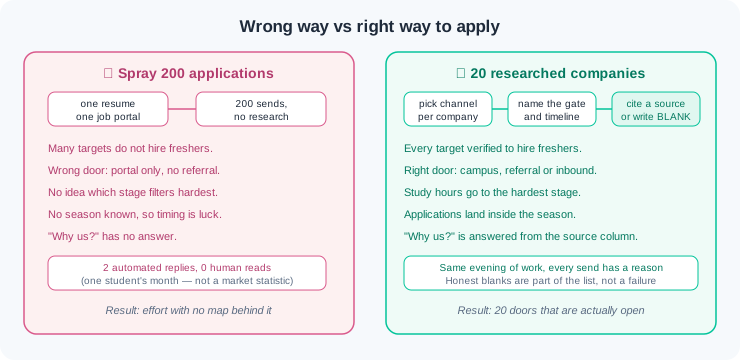
Ramya is in her final year at a college in Kurnool. Over one month she sent two hundred applications through a single job portal. She used the same resume every time. Two replies came back, and both were automated. Her senior asked one question: which of these companies hires freshers, and through which door? Ramya had no answer. She had been posting letters without checking whether the address existed. This module is the map she was missing.
- You are about to spend months building skills. This module tells you which doors those skills open, so the effort lands somewhere real.
- Two hundred blind applications and twenty researched ones cost the same evening of work. Only one of the two gets read by a person.
- Recruiters, seniors and coaching centres will all make claims about your future. After today you will ask for the source, and you will know which sources exist.
India does not have one hiring market for AI work. It has four, and they work in different ways. The first is IT services, the large firms that build and run software for other companies. The second is the GCC — a global capability centre, the India office that a foreign company owns and staffs itself. The third is product startups, and the fourth is smaller services shops and consultancies.
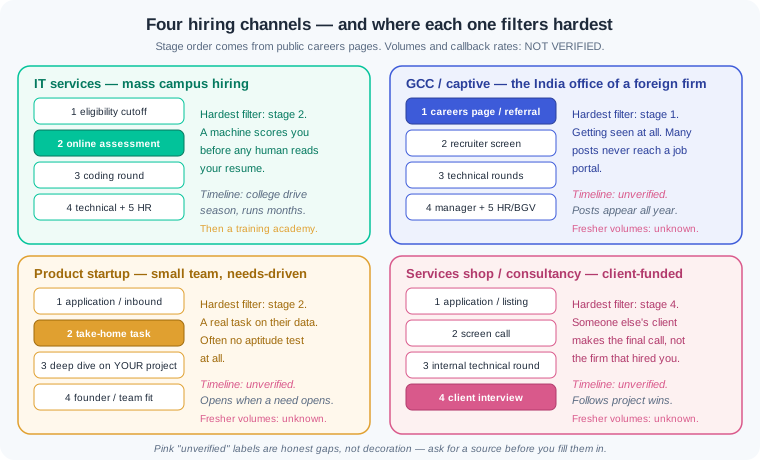
Each channel hires through a hiring funnel — the fixed set of stages your application must pass, from first click to offer. On paper the stages look alike: application, test, coding round, technical talk, then a talk with human resources. What differs is which stage does the real filtering. Knowing that stage tells you where to spend your study hours.
An online assessment — a timed test you take at home or in a lab, scored by a machine — is the first hard gate at most large firms. It is where the biggest cut happens, and no human reads your resume before it. Startups often skip it and open with a take-home task or a call. Consultancies sit in between and lean on a client round at the end. The figure below maps all four channels.
Where does your application actually land? Four doors exist. Campus placement runs through your college and needs no cover letter, but it only reaches firms your college has tied up with. An off-campus application — one you send yourself through a careers page or a job portal — reaches everyone and is read by almost nobody. A referral — an application passed on by someone already inside the company — skips the pile, and portfolio-inbound means a recruiter found your public work first.
We cannot give you honest numbers for those four doors. Nobody publishes verified callback rates for Tier 2 and Tier 3 students in India, and our research pass found none that survived checking. What we can say is the shape working engineers describe: referrals and campus reach a human fastest, and cold portal applications reach one slowest. Treat that as reported experience, not as data. If anyone hands you a percentage here, ask them where it came from.
Here is the contrast this module exists for. The wrong way is Ramya's month: two hundred near-identical applications, one channel, no research, no idea which firm even hires freshers for this work. The right way is a list of twenty companies, each with its channel, its gate, its season, and a source for every claim. Twenty researched applications beat two hundred sprayed ones, because each one enters a door that is open. The short list also survives a question no recruiter will skip: why us?
One hiring fact in this whole module survived hard checking. Infosys reported 12,000 fresher hires in the first half of FY26 and met a 20,000 full-year target. Its fresher pay ladder runs at roughly 7, 11, 16 and 21 lakh rupees, against a mass entry tier near 3.6 to 4 lakh. The top rung is tied to AI skills and is opened by an internal test. That is one company in one year, and it does not describe the rest of the market.
Now read a job description — the company's written advert for a role, listing the tasks and the skills it wants. Titles in India inflate. A post named GenAI Engineer may cover prompt writing, data cleaning, or hand-labelling text all day. The tasks section tells the truth, while the title sells the post. Read the verbs, not the noun.
Seasons matter too. Campus drives at many colleges cluster in the months before final exams, and off-campus fresher openings appear through the year in bursts. We could not verify a national hiring calendar, so build your own. For every company on your list, note when its last fresher drive happened and where you read that. A dated line from a careers page beats a confident claim in a classroom.
That habit of demanding a source is the real skill in this module. Four sources can be checked by anyone: the company annual report, the quarterly results page, the official careers page, and news reporting that names its own source. A placement claim with no company name, no year and no offer letter is marketing. Ask for those three things and watch what happens. Apply the same test to us, including every line above.
This module has no code. What it has instead are five artefacts you will copy into your own notes file and fill in for yourself. Read each one with the same question in mind: which line here is a fact with a source, and which line is somebody's sales pitch?
Artefact 1 — a job description, pulled apart line by line. The posting below is a composite we wrote to look like the real thing. It is not a real advert from any company, and no number in it is a claim about the market:
ROLE : GenAI Engineer - Fresher                     [composite example]
LOC  : Bengaluru, work from office
--------------------------------------------------------------------
1  "Join our AI Center of Excellence and build the future"      NOISE
2  "0-1 years experience, B.E./B.Tech any branch"               SIGNAL
3  "Strong Python; ability to write clean, tested code"         SIGNAL
4  "Experience with LLMs, prompt engineering, RAG pipelines"    SIGNAL
5  "Familiar with LangChain, LlamaIndex, vector databases"      SIGNAL
6  "Support annotation and quality review of training data"     SIGNAL *
7  "Prepare weekly status decks for client stakeholders"        SIGNAL *
8  "Passion for AI, go-getter, rockstar mindset"                NOISE
9  "Cutting-edge exposure to Gen AI, ML, DL, NLP, CV, MLOps"    NOISE
10 "Immediate joiners preferred; 2-year service agreement"      SIGNAL !
Read it the way a hiring manager wrote it. Lines 1, 8 and 9 are advertising: they describe a feeling, not a task, and line 9 lists six fields nobody does at once. Lines 2 to 5 are the honest requirement and map to real spine modules. Lines 6 and 7 carry the star because they are the actual daily work hiding under the title: labelling data and writing status decks may be most of this job. Line 10 carries the exclamation mark because a service agreement is a contract term, not a skill, and you must read it before you sign. Verdict: a real fresher role with real LLM exposure, but the title oversells it — and WR-150 is what happens when nobody asks.
Artefact 2 — the four-channel funnel, and what each stage removes. One table, four channels, honest labels on what we could not verify:
CHANNEL          STAGES (in order)                 HARDEST FILTER      TIMELINE
--------------------------------------------------------------------------------
IT services      1 eligibility cutoff              stage 2, the        multi-month,
(mass campus)    2 online assessment (aptitude+    machine-scored      college-drive
                   logical+verbal+pseudo-code)     test                season
                 3 coding round
                 4 technical interview
                 5 HR interview + service bond
                 6 training academy, then project

GCC / captive    1 careers page or referral        stage 1, getting    unverified;
                 2 recruiter screen                seen at all         posts appear
                 3 technical round(s)                                  through year
                 4 hiring-manager round
                 5 HR + background check

Product          1 application or inbound          stage 2, the        unverified;
startup          2 take-home task or screen call   take-home           needs-driven
                 3 technical deep dive on YOUR
                   project
                 4 founder or team-fit round

Services shop /  1 application or vendor listing   stage 4, the        unverified;
consultancy      2 screen call                     client round        project-driven
                 3 internal technical round
                 4 client interview (the real gate)

VERIFIED: only the Infosys figures in artefact 4. Stage ORDER above is the
shape reported by working engineers and by public careers pages. Fresher
VOLUMES and callback rates per channel: NOT VERIFIED. Do not quote them.
Two lessons sit in this table. First, the hardest filter moves: at IT services it is a machine, at a GCC it is visibility, at a startup it is your own project, at a consultancy it is somebody else's client. Second, look at what is marked unverified. We can describe the shape of a funnel from public careers pages, but we cannot tell you how many freshers each channel hires, so we do not.
Artefact 3 — a company-research worksheet, filled in honestly. Every field names its source, and every field we could not source stays blank:
COMPANY RESEARCH WORKSHEET
Company            : Infosys
Channel            : IT services, mass campus + off-campus drives
                     SOURCE: company careers page (careers section, infosys.com)
Fresher hiring?    : Yes - 12,000 in H1 FY26; 20,000 full-year target met
                     SOURCE: quarterly results + management commentary, FY26;
                     re-checkable at infosys.com > Investors > Financials
Gate type          : Assessment-gated ladder; top pay rung tied to AI skills
                     SOURCE: same as above
Pay ladder         : approx Rs 7L / Rs 11L / Rs 16L / Rs 21L; mass tier
                     approx Rs 3.6L-4L    SOURCE: same as above
Next drive date    : ____________  (BLANK - no verified public calendar found)
Callback rate for  : ____________  (BLANK - nobody publishes this; any number
Tier-2/3 students                   you are offered here needs a source)
Team I would join  : ____________  (BLANK - ask in the interview, do not guess)
Referral contact   : ____________  (fill from your own college alumni list)
Last checked on    : write today's date here, and re-check before you apply
Count the blanks. Four of the nine fields are empty, and that is the worksheet working correctly. A worksheet with no blanks is either a company you know unusually well or a page you filled from rumour. The two rules are fixed: every filled field names where you read it, and every blank stays a blank until a source appears. The date line matters because hiring facts go stale within a quarter.
Artefact 4 — the one verified fact, presented the way a fact should be presented. Keep this card as your model for every hiring claim you ever repeat:
FACT CARD
Claim   : Infosys hired 12,000 freshers in H1 FY26 and met its 20,000
          full-year fresher target.
Claim   : Infosys fresher pay ladder is approximately Rs 7L / Rs 11L /
          Rs 16L / Rs 21L, with the top rung tied to AI skills and opened
          by an internal assessment; mass entry tier approx Rs 3.6L-4L.
Status  : VERIFIED - survived three independent adversarial checks in this
          programme's research pass.
Check it: Infosys investor-relations pages - quarterly results releases and
          management commentary, plus the FY26 annual report.
Limits  : ONE company. ONE financial year. Headcount targets and pay bands
          are revised every few quarters. Says nothing about GCCs, startups,
          consultancies, or any other IT-services firm.
Misuse  : Do NOT repeat this as "IT services freshers earn Rs 21 lakh".
          The Rs 21L rung is the top of a gated ladder, not the normal offer.
          The honest one-line version is: at ONE large IT-services firm, in
          ONE year, an AI-skill gate separated a Rs 21L tier from a Rs 3.6L
          tier - which is why gated AI skill is worth building.
The Misuse line is the point of the card. The same fact can be told honestly or dishonestly, and the difference is whether the limits travel with it. When you quote this in an interview, quote the limits too — an interviewer who knows the market will notice, and it marks you as someone who reads sources.
Artefact 5 — the target list, with three example rows. This is the deliverable of the module, and exercise 1 grows it to twenty rows:
# | COMPANY   | CHANNEL      | GATE TYPE        | TIMELINE     | SOURCE / STATUS
--+-----------+--------------+------------------+--------------+------------------
1 | Infosys   | IT services, | online assess-   | college      | careers page +
  |           | campus + off | ment, then       | drive season | quarterly results
  |           | campus       | coding, then     | (dates NOT   | (verified; see
  |           |              | interviews       | verified)    | fact card)
--+-----------+--------------+------------------+--------------+------------------
2 | <bank GCC | GCC /        | recruiter screen | rolling      | careers page,
  | in your   | captive      | then technical   | postings     | checked 12 Aug;
  | state>    |              | rounds; NO mass  | (unverified) | no volumes found
  |           |              | test seen        |              |
--+-----------+--------------+------------------+--------------+------------------
3 | <logistics| product      | take-home task   | needs-based, | careers page +
  | startup,  | startup      | on THEIR data,   | no season    | founder post on
  | Series A> |              | then project     | found        | a public profile
  |           |              | deep dive        |              | (dated, checked)
Read the SOURCE column, not the COMPANY column. Row 1 is the only row where a hiring volume is verified, and it is the only row allowed to state one. Rows 2 and 3 name what was checked and on which date, and they leave the volume out because no source existed. A list built this way has a second use: at interview, the SOURCE column is your answer to "what do you know about us", and it is an answer almost no other fresher can give.
Work in a file called target-list.md inside your notes folder. Every claim you write down carries a source line or the word BLANK. No exceptions, including for claims made by people you trust.
Build your twenty-company target list. Using the artefact 5 template, build a list of twenty companies you would actually apply to. Cover all four channels: at least six IT services, at least four GCCs or captives, at least four product startups, and at least three services shops or consultancies. For every row fill five columns — company, channel, gate type, timeline, and source. Allowed sources are the company careers page, its annual report, its quarterly results page, and dated news reporting that names its own source. Where nothing verifiable exists, write BLANK and the date you looked. Add a sixth column naming your intended door for that company: campus, off campus, referral, or portfolio-inbound. Check: the file holds twenty rows across all four channels; every filled cell carries a source or a BLANK marker; at least four cells are honestly BLANK; you can point to one row where you changed your intended door after reading the careers page; and your last line names the one company on the list whose process you understand best, with the reason.
Dissect three real job descriptions. Find three real fresher or 0-2 year postings that mention AI, machine learning or data work, one from each of three different channels. Copy each into your notes with its link and the date. For each posting, mark every line as SIGNAL or NOISE the way artefact 1 does. Then write three short answers: what the daily work actually looks like based on the task verbs, which spine modules cover the named skills, and where your own gap sits today. Finish each one with a one-line verdict: apply now, apply after which module, or skip and why. Check: three postings are saved with links and dates; every line in each is marked SIGNAL or NOISE; each posting has a task-verb summary that does not repeat the job title; each names at least two spine module numbers; each carries an honest gap line naming something you cannot do yet; and at least one of the three earns a skip or a delay verdict.
Audit a placement claim. Find one placement claim aimed at students — a coaching centre banner, a college brochure, a training advert, or a social media post. Copy the exact wording into your notes. Now write the five questions that would make the claim checkable: which named companies, in which year, for which roles, at what pay, and what document proves it. Try to answer each question using only the four allowed sources. Record what you found and what you could not find. Then write the same audit on a claim made by this programme, using the fact card in artefact 4 as your target. Check: the exact claim wording is copied, not paraphrased; five checkable questions are written; each question has a found or not-found result with the source named; you state in one sentence whether the claim is verifiable, partly verifiable, or marketing; and your audit of our own Infosys fact card correctly notes both what is verified and the limits printed on the card.
Three job-search failures cover most of the pain in a first placement season. Each has a War Room entry with the full diagnosis path:
- WR-148 — the two hundred application black hole. A student sent mass identical applications through one portal, got zero callbacks, and blamed the market; the fix is channel fit, referrals through the alumni list, and public work that brings recruiters inbound.
- WR-149 — the coaching centre promise. A family paid a fee for a written "100% placement guarantee" that named no company, no year and no role; the fix is the five questions that expose an unverifiable claim before any money moves.
- WR-150 — the job description that was not the job. A fresher accepted a GenAI Engineer title and spent nine months hand-labelling text; the fix is asking about the daily work, the team and the stack before signing anything.
India hires AI freshers through four channels, and each one does its hardest filtering at a different stage. Your application reaches a company through one of four doors: campus, off campus, a referral, or your own public work. A job description sells a title, so read the task verbs to learn what the work really is. Only one hiring fact in this module survived checking, and one company in one year does not describe a whole market. Build a list of twenty companies, each carrying a channel, a gate, a timeline and a source for every line you write.
- Campus placement cells at Indian colleges run the IT-services drives most students meet first. The channel map in this module is close to what a placement coordinator uses when planning a season.
- A bank GCC in India posts many fresher roles only on its own careers page and fills others through referrals. Students who never look past job portals never see those posts at all.
- Fee-charging placement agencies advertise guaranteed jobs to students every year. The five source questions you drill today are what separate a real offer pipeline from a sales pitch.
Answer these before opening the gate assessment. Each question names its kind.
type=interpretation— A posting titled "AI Engineer - Fresher" lists these tasks: review model outputs against a rubric, tag errors in a tracker, raise weekly quality reports, and escalate edge cases to the data science team. Read the verbs and state what the daily work actually is, then say what the title is doing.type=scenario-judgement— A coaching centre tells you "94% of our students are placed in AI roles within six months" and shows a wall of photographs. Give your ruling on the claim and list the exact things you would ask to see before paying anything.type=debug— A classmate's target-list row reads: company a product startup, channel IT services, gate type online aptitude test, timeline campus drive season, source "my senior told me". Find every field that is wrong or unsupported, and say what evidence would fix each one.type=trade-off— Two hundred identical portal applications versus twenty researched applications with matched channels. Give one concrete gain and one concrete cost of each approach, then name the evidence you would collect over four weeks before deciding which to continue.type=output-prediction— A student with a strong public project but weak speed on timed aptitude tests applies to a large IT-services firm through the campus drive and to a product startup through a referral. Predict the stage at which each application is most likely to stop, and explain what in the funnel shape drives your prediction.
Explain to a friend in a non-technical degree how AI hiring in India actually works, using the post-office idea from the scene. Cover why sending the same letter to two hundred addresses fails, what the four different doors into a company are, and why a job title on a poster can promise work that the poster's own task list does not match. Then tell your friend the one question to ask anybody who promises them a job. Use at most 4 sentences and no technical word beyond "application". If your friend can name the four doors and the one question, you own this module.