Communication for Indian students
Sowmya had the right answer. The panel in Nizamabad asked how she handled missing data in her churn model. She knew it cold. She had dropped one column, filled another with medians, and written down why. It came out as one long rush, ninety seconds with no full stop, every point folded into the one before it. The interviewer wrote two words on her sheet: unclear thinking. Her answer was correct. Nobody in that room could find it.
- Your English is not on trial in this round. Being understood is the whole bar, and structure clears it faster than vocabulary does.
- Nerves speed you up, and speed hides good answers. A slower answer with a shape beats a faster answer with better content.
- Every other round in this phase passes through your mouth. The theory viva, the case round and the project defence are all scored through this one skill.
Start with a ruling this module will not move from. Indian English is correct English. Your accent is not a defect, and no interviewer worth working for scores it. The bar is one thing only: can the listener follow you? That bar is reachable this month, and it has nothing to do with sounding foreign.
If you studied in a regional-medium school, you are not behind. The thinking that built your project took years. The English words for it take weeks, and you are already collecting them. What slows students down is rarely vocabulary. It is pace, shape, and the habit of apologising.
Nerves make you fast. Under pressure your speech rate climbs, pauses vanish, and your best sentence lands on top of the last one. The fix is deliberate. Say your opening line slower than feels right, and the rest of the answer follows that speed.
A pause reads as thinking, not as a gap. Two seconds of silence feels long to you and normal to the listener. Fill it with air, not with sound. A filler word — a noise like um, aa, actually or basically that buys you time — costs more than the silence would have. Speak a shade louder than you do with friends, because volume carries steadiness you may not feel yet.
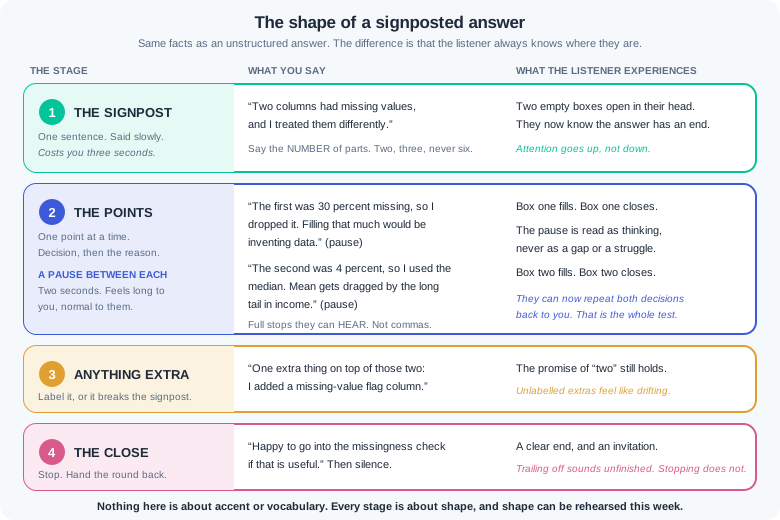
The strongest habit in this module takes one sentence. Signposting — saying how many points you will make before you make them — hands the listener the shape of your answer. "There were two problems, and I will take them in order." Now every sentence after that has a place to sit. The figure shows what the listener experiences at each stage of a signposted answer.
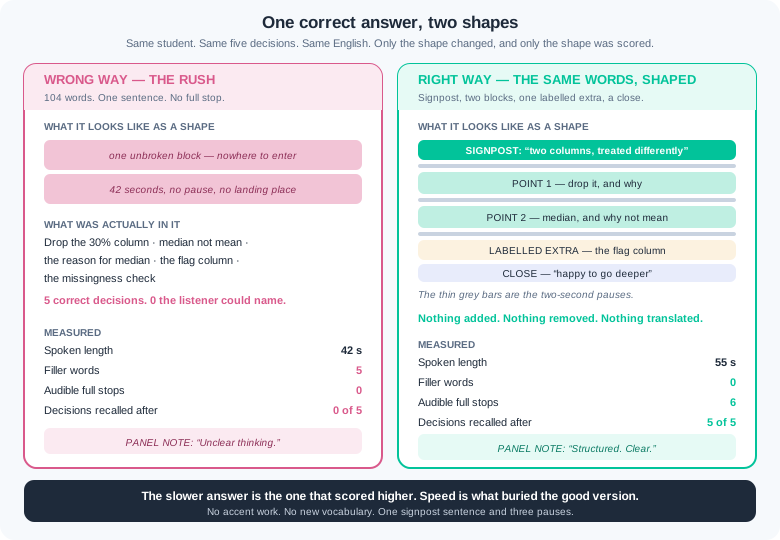
Here is the contrast this module exists for. One student gives a correct answer as a single ninety-second rush, and the panel writes "unclear thinking". Another gives the same facts in the same order, with one signpost and two pauses, and the panel writes "structured". Nothing was added and nothing was removed. Only the shape changed.
STAR is the story shape for every "tell me about a time" question. Situation, Task, Action, Result, in that order. Freshers worry that they have no jobs to draw on, and that worry is misplaced. Your spine projects and your War Room incidents are real situations with real results. A bug you chased for two days beats an internship where you watched.
Keep STAR honest. Result does not mean success. It means what happened and what you learnt. "The score did not move, and here is what that told me" is a complete answer. Never invent a team you did not have or a scale you never reached.
Half your rounds have a non-technical listener in the room. Use the explanation ladder — one plain sentence, then an analogy, then the detail only if they ask. Rung one for the churn model sounds like this: it spots customers who are about to stop ordering, while there is still time to call them. Rung two is the analogy, and rung three is the feature list. You climb only when invited.
Most students open at rung three and lose the room in ten seconds. The ladder is not talking down to anybody. It is ordering. An HR manager who follows rung one will fund your project, and an engineer who wants rung three will ask for it.
When a question is unclear, the cheapest move is clarify-then-answer — one short check before you spend two minutes. "When you say scale, do you mean more users or more data?" The interviewer answers in four words, and your whole answer lands on target. Students skip this because asking feels weak. In the room it reads as senior, because a wrong guess wastes the answer and the time.
Three hard moments will arrive, and each has a script. When you cannot answer, say so and then say how you would find out. When you are interrupted, stop mid-word and take the new question. When you catch your own mistake mid-answer, name it out loud and correct it, because a self-correction buys more trust than a tidy wrong answer.
Written communication is scored too, and more often than students expect. A clear email, a short status update, a commit message that says why, and a pull request description a reviewer can act on. Module 0.2 taught those as version control habits. They are communication, and your first manager will read them every day.
Indian workplaces mix languages all day, and that is normal. Register — the level of formality a situation calls for — is the real skill, not erasing how you speak. Hinglish in a stand-up is fine, and the same sentence in a client email is not. Learn to move between registers and keep every one of them. Nobody here is asking you to sound like somebody else.
Many Indian interviews run in a mix of English and the local language. Asking "may I explain this part in Telugu?" is a normal move at plenty of Indian companies. It works best when the panel is local, or when the interviewer has already mixed languages. It is not available in a global panel, a client-facing role, or a video round with people from other states. Ask once, early, and give the summary in English either way.
Fluency practice that helps a technical candidate looks nothing like grammar drills. Shadow technical talks: play thirty seconds, pause, and say it back in your own words. Read your own answers aloud until the sentences fit your mouth. Record yourself and listen twice, once for pace and once for shape. Build a technical phrasebook — your own list of the twenty phrases you need in every round, written the way you would say them.
Nervousness is information, not a character flaw. It tells you the round matters and that this answer has not been said aloud enough times. It drops with rehearsal and with structure. It does not drop because somebody told you to be confident. Twenty spoken rehearsals beat twenty silent readings, and that is the whole cure.
Six worked transcripts. Read the block, then read the notes under it. Every one uses work you already own: the churn model from Phase 1 and Phase 4, and the RAG assistant from Phase 3.
Transcript 1 — the right answer, delivered as one rush. This is Sowmya's answer, written down exactly as it was spoken:
# TRANSCRIPT 1 - THE RUSH. Correct content, unfindable. Annotated.

Q: How did you handle missing data in the churn project?

A: So basically there were missing values in two columns and I checked
   how many were missing and it was around 30 percent in one and like
   4 percent in the other so for the first one I dropped it because 30
   percent is too much and filling it would basically create fake data
   and for the other one I used median not mean because there are
   outliers in the income column and mean would get pulled up and I
   also added a flag column so the model knows the value was missing
   and actually I checked whether the missingness itself was related
   to churn and it was slightly so the flag helped a bit and that is
   basically what I did.

   [1] 104 words. ONE sentence. No full stop anywhere in it.
   [2] EVERY FACT IS CORRECT. This is the part students miss. There is
       no knowledge gap here and no grammar mistake here either.
   [3] Five separate decisions are buried inside: drop the column,
       median not mean, the reason for median, the flag column, the
       missingness check. The listener heard one long noise and can
       name none of the five.
   [4] Filler count: "basically" x3, "like" x1, "actually" x1. Filler
       arrives when the mouth is running ahead of the plan.
   [5] No signpost at the start, so the listener had no boxes open. She
       was still building the shape while he was already filling it.
   [6] Spoken length 42 seconds. Fast is not the same as efficient.

INTERVIEWER'S NOTE: "Knows the tools. Unclear thinking - could not
structure a simple answer."

WHAT THE NOTE IS ACTUALLY ABOUT: her delivery, scored as her thinking.
That is the whole failure, and it is not an English failure. The
sentences are grammatical. They arrived with no shape.
Read line [2] twice, because it is the reason this module exists. Nothing in that paragraph is wrong, and the round was still lost. Line [3] is the mechanism: five decisions with no boundaries between them arrive as zero decisions, since a listener can only hold what they can separate. Line [4] is worth counting on your own recordings, because filler is a symptom of speed and not a symptom of weak English — the same student writes clean paragraphs. Line [6] is the surprise: the bad answer was the shorter one. Speed is what buried it, so the repair is not more words.
Transcript 2 — the same facts, signposted and paced. Same student, same project, same five decisions, two weeks of the right practice:
# TRANSCRIPT 2 - THE SAME ANSWER, RESHAPED. Nothing added, nothing cut.

Q: How did you handle missing data in the churn project?

A: Two columns had missing values, and I treated them differently.
   [1] THE SIGNPOST. One sentence, said slowly. The listener now has
       two boxes open and knows the answer has an end.
   (pause - two seconds)

   The first column was 30 percent missing, so I dropped it. Filling
   that much would be inventing data, not recovering it.
   [2] BOX ONE: the decision, then the reason. Two sentences, then a
       full stop the listener can hear.
   (pause - two seconds)

   The second was 4 percent missing, so I filled it with the median.
   I chose median over mean because the income column has a long tail,
   and the mean gets dragged by it.
   [3] BOX TWO: decision, reason, mechanism. She gave the median-versus-
       mean reason before anybody asked, which removes a follow-up.
   (pause)

   One extra thing on top of those two: I added a flag column marking
   which rows had been missing. Missingness was slightly linked to
   churn, so the flag carried a little real signal.
   [4] THE BONUS, marked as a bonus. "One extra thing on top of those
       two" protects the signpost - the answer still had two parts.

   Happy to go into the missingness check if that is useful.
   [5] THE HANDOVER. She stops and lets the interviewer steer.

SAME FACTS. ALMOST THE SAME WORDS.
   Spoken length     55 seconds   (up from 42)
   Filler words      0            (down from 5)
   Decisions the listener could repeat back afterwards: 5 (up from 0)

INTERVIEWER'S NOTE: "Structured. Gave the median reason without being
asked. Clear."
Put transcripts 1 and 2 side by side and count what actually changed: one signpost sentence, three pauses, and full stops in audible places. No new vocabulary, no new content, no accent work. Line [1] is the cheapest sentence in this module — "two columns, and I treated them differently" costs three seconds and it buys a listener who can follow the rest. Line [4] shows the rule for extra material: anything outside your signpost must be labelled as extra, or it breaks the promise you made in sentence one. Line [5] hands the round back, which is what a confident answer sounds like. Notice the good answer is thirteen seconds longer, so slower really is the direction of travel.
Transcript 3 — the explanation ladder, on both spine projects. The listener here is a business manager who has never written code:
# TRANSCRIPT 3 - THE LADDER. Climb one rung at a time, on request.

=== PROJECT A: THE CHURN MODEL ==============================

Q (a retention manager at a kirana delivery chain):
   So what does your model actually do?

RUNG 1 - ONE PLAIN SENTENCE. Say this and STOP.
A: It points out the customers who are about to stop ordering, while
   there is still time to call them.
   [1] No model name. No feature count. No metric. One outcome, in
       words she already owns. This sentence must be rehearsed.

Q: How does it know that?

RUNG 2 - THE ANALOGY. Only after she asks.
A: Think of an experienced shop owner who notices that a regular
   customer has not come in for three weeks, and that when he does
   come, he buys less than he used to. The model does the same
   noticing across 500 customers at once, every night.
   [2] The analogy uses HER world, not a computing world. "It is like
       a neural network" is not an analogy; it is a second unknown.
   [3] Notice what the analogy smuggles in correctly: recency and
       falling basket size are two of the six real features.

Q: And how well does it work?

RUNG 3 - THE DETAIL. She asked, so climb.
A: On my test set it catches 26 of the 39 customers who actually left,
   at the shipped threshold. Doing nothing at all scores 0.688 on
   accuracy, and the model scores 0.824. It misses 13 of the 39, which
   is the number I would attack next.
   [4] Counts BEFORE ratios. "26 of 39" is a fact she can act on.
       "Recall 0.667" is a fact she has to translate.
   [5] Baseline first, then the score, then the honest miss.

=== PROJECT B: THE RAG ASSISTANT ============================

Q (an HR head): What is this policy assistant of yours?

RUNG 1: It answers HR policy questions by reading the policy document
   first, so the answer comes from your document and not from the
   model's memory.

RUNG 2 (asked): It is the difference between an employee answering
   from memory and an employee who opens the handbook, finds the
   paragraph, and reads it back to you with the page number.

RUNG 3 (asked): It pulls the three closest paragraphs out of 14 by
   similarity, then answers only from those three. On my 12 test
   cases it found the right paragraph in 10. One of the 12 is a
   question the document cannot answer, and passing that case means
   refusing to answer it.

RULE: the wrong rung is the expensive mistake in both directions.
Rung 3 to a manager loses the room in ten seconds. Rung 1 to a senior
engineer sounds like you do not know the detail. Read the listener,
start low, and climb only when asked.
The ladder is one habit with two failure modes, and students almost always fail in the same direction. Line [1] is a sentence you write down and rehearse, because "one plain sentence" is easy to agree with and hard to produce under pressure. Line [2] names the analogy trap: a comparison is only useful if it is built from things the listener already has, so a shop owner works and a neural network does not. Line [4] is the habit from module 6.4 wearing plain clothes — counts land, ratios need translating, and a manager who hears "26 of 39" can price the decision herself. The closing rule matters as much as the ladder: climbing too slowly with an engineer costs you as much as starting too high with a manager.
Transcript 4 — clarify-then-answer, on an ambiguous question. Same question, two candidates:
# TRANSCRIPT 4 - THE CLARIFY MOVE. One line saves two minutes.

Q: How would you scale this churn model?

--- VERSION A: THE GUESS (fails, and expensively) ---
A: I would put it behind a load balancer, run several containers, add
   caching for repeated requests, and use auto-scaling on CPU.
   [1] Fluent. Confident. Two minutes long. Aimed at "more traffic".

Q: I meant the data. You have 500 rows. What changes at 5 crore rows?
A: Oh. Sorry, then... training would be slower, I suppose.
   [2] The real answer had to start over, with the clock down two
       minutes and the candidate now off balance.
   [3] The cost is not only time. He has shown that he answers before
       he understands, which is a habit an interviewer will price.

--- VERSION B: THE CLARIFY MOVE ---
A: One quick check, so I answer the right question: do you mean more
   requests coming in, or a much larger training table?
   [4] ONE sentence. Names the two readings. Costs four seconds.
   [5] The framing matters - "so I answer the right question" says
       this is precision, not confusion.

Q: The training table. Take it to 5 crore rows.
A: Then I will take it in three parts: what stays the same, what
   breaks, and what I would watch.
   [6] SIGNPOST, immediately. Now the answer has a shape.

   What stays the same: the six features, the target definition, the
   stratified split and recall as the metric. None of those care about
   row count.
   What breaks first: my data step. It regenerates a seeded table in
   memory today, so at 5 crore rows that becomes a warehouse query
   with a date filter. The one-hot encoding on city is the second
   break, because pincodes at national scale give me hundreds of
   columns.
   What I would watch: the class balance. My 39 churners in 125 test
   rows give recall a wide error bar, and at 5 crore rows that number
   becomes trustworthy for the first time, so I would re-run the
   threshold sweep before shipping anything.
   [7] Same candidate, same knowledge. The four-second question is
       the only difference between versions A and B.

WHEN TO USE IT: the question has two readings, or a word in it is
vague - scale, better, optimise, improve, handle.
WHEN NOT TO USE IT: the question is clear and you are stalling.
Clarifying a clear question reads as avoidance. One check, not three.
The four-second sentence in line [4] is the highest-return habit in this module. Line [1] is what students believe strength sounds like, and it is why the guess is so common: version A is fluent, fast and completely off target. Line [3] names the hidden cost — the interviewer now knows this candidate will build the wrong thing for two weeks before asking, which is a real workplace risk. Line [5] is worth copying word for word, since "so I answer the right question" turns a check into a display of care. And line [6] shows the two habits stacking: clarify first, then signpost, and the rest of the answer almost writes itself.
Transcript 5 — the three hard moments. These are the moments students fear, and each one has a script that takes under ten seconds:
# TRANSCRIPT 5 - THREE HARD MOMENTS, WITH THE ACTUAL WORDS.

=== MOMENT 1: A QUESTION YOU CANNOT ANSWER =================

Q: How would you shard the vector store across regions for DPDP
   residency rules?

--- WEAK: the fog ---
A: So there are various approaches, it depends on the requirements,
   generally you would design it based on the use case...
   [1] Forty seconds of words with no content. Everyone in the room
       knows what is happening, including the candidate.

--- WEAK: the apology spiral (this is WR-167) ---
A: Sorry sir, I do not know, sorry, my knowledge is limited in this
   area, sorry...
   [2] The gap was normal. The four apologies are what the panel
       remembers, and they contaminate the next three answers too.

--- STRONG: say it, then say how you would find out ---
A: I have not built a sharded vector store, so let me tell you what I
   do have and where my line is.
   I have built a single-node store over 14 chunks and measured
   retrieval on 12 cases, so I know the retrieval side.
   On residency, what I understand is that Indian personal data may
   have to stay in an Indian region, which makes it a placement
   problem before it is a performance problem.
   To close the gap I would read the DPDP rules on cross-border
   transfer, look at how our cloud provider does regional replicas,
   and ask whoever owns the compliance sign-off what is already
   agreed.
   [3] Four sentences, ten seconds each. No apology anywhere, because
       not knowing is not an offence. Named a document, a system and
       a person.

=== MOMENT 2: THE INTERVIEWER INTERRUPTS ===================

A: ...so after the split I fit the scaler inside the Pipeline, which
   means it refits on every fold and never sees a-
Q: Sorry, quick one - what was your test size?

--- WEAK ---
A: ...never sees a test row, and then after that I trained the-
   [4] He finished his sentence. It reads as not listening, and the
       interviewer now has to ask twice.

--- STRONG ---
A: 125 rows, 25 percent, stratified.
   (pause)
   Shall I carry on with the Pipeline, or is there something else on
   the split?
   [5] Stopped mid-word. Answered in six words. Then OFFERED the
       thread back instead of grabbing it.
   [6] An interruption is usually interest, not rudeness. She wants
       that number before the rest lands on top of it.

=== MOMENT 3: YOU CATCH YOUR OWN MISTAKE MID-ANSWER =========

A: ...and the baseline was 0.74, so the model at 0.824 beat it by
   about eight points-

--- WEAK: push through and hope ---
A: -by about eight points, which was a good improvement.
   [7] He knows 0.74 was the OLD table's baseline. He said it anyway
       and hoped nobody had the number. Somebody always has it.

--- STRONG: name it and correct it, out loud ---
A: -sorry, let me correct that number. 0.74 was the baseline on my
   earlier table with 26 churners. This table has 39 churners in 125
   rows, so the do-nothing baseline is 0.688 and the gap is about
   fourteen points. The rule is the same either way: the baseline
   belongs to the data, not to the model.
   [8] "Let me correct that number" is the whole move, and it is one
       sentence. She now knows your numbers can be trusted, because
       you police them yourself when nobody has caught you.

THE PATTERN IN ALL THREE: name what is happening, in one short
sentence, then keep moving. Silence and fog are what cost marks.
Naming costs nothing.
All three scripts share one shape: say the true thing in a short sentence, then go forward. Moment 1's strong version gives ground you do hold before naming the gap, and that order matters, because "I do not know" alone is honest and empty. Moment 2 is the easiest mark in this module and the one students drop most often — stopping mid-word is a skill you can practise in one sitting. Moment 3 is the one that quietly wins rounds, since a candidate who corrects their own number is a candidate whose other numbers can be believed. Notice that none of the six weak versions failed on English, and none of the three strong versions used a harder word than the weak one.
Transcript 6 — written communication, before and after. Your writing is read by more people than your speaking is heard by:
# TRANSCRIPT 6 - WRITTEN WORK, REWRITTEN.

=== A: THE STATUS UPDATE TO YOUR MANAGER ===================

--- BEFORE ---
Subject: update

Hi sir,
I am working on the model. There are some issues with the data. I am
trying to fix it. Will update you.
Thanks

   [1] The manager cannot act on one word of this. She now has to
       write back and ask three questions, which is work you handed
       to her.
   [2] "Some issues" and "trying to fix" hide the two things she
       needs: is it on time, and does she have to do anything?

--- AFTER ---
Subject: Churn model - on track for Friday, one decision needed

Hi Devanshi,

Status: on track for the Friday demo.

Done this week: features built and the baseline measured. Doing
nothing scores 0.688, so that is the number to beat.

The problem: 30 percent of the income column is missing. Filling that
much would be inventing data, so I plan to drop the column and add a
missing-value flag instead.

What I need from you: confirm by Wednesday that dropping income is
acceptable to the retention team. If it is not, I will need another
two days to source the field from the billing system.

Thanks,
Sowmya

   [3] The verdict is in the subject line. A busy manager reads
       subject lines and skims the rest.
   [4] Four labelled parts: status, done, problem, ask. The ask has a
       DATE and a named consequence.
   [5] The problem is stated with the plan already attached. Bringing
       a problem alone is a question; bringing a problem with a plan
       is an update.
   [6] Same length as the vague one, roughly. Clear is not longer.

=== B: THE PULL REQUEST DESCRIPTION ========================

--- BEFORE ---
Title: fixes
Description: fixed the bug in preprocessing

   [1] The reviewer has to read the whole diff to learn what you
       already know. That is your work, moved onto them.
   [2] In six months, git log says "fixes" and nobody can find when
       this changed or why.

--- AFTER ---
Title: fix(preprocess): fit scaler inside the Pipeline to stop leakage

## What
Moved StandardScaler from a standalone fit() before the split into
the sklearn Pipeline, so it refits inside every fold.

## Why
The scaler was being fitted on all rows including the test set, so
test-set statistics were leaking into training. Cross-validation
scores were about a point too high.

## Evidence
CV accuracy 0.831 -> 0.824 after the fix. The drop is the leak
being removed, not a regression.

## Risk
Low. No change to features or to the model. tests/test_pipeline.py
now asserts the scaler is a Pipeline step.

   [3] Title says WHAT and WHERE in nine words. This line becomes
       git history and gets read for years.
   [4] "Why" is the section reviewers actually need, because the diff
       already shows them the what.
   [5] The score went DOWN and he still shipped it, with a sentence
       explaining why a lower number is the correct one here. That
       sentence is the reason this PR gets approved quickly.
   [6] "Risk" tells the reviewer how carefully to read. Senior people
       decide review depth from that one line.

THE RULE FOR BOTH: write the verdict first, then the reason, then what
you need. Nobody in a workplace reads a paragraph looking for a point.
Written work is where a slow, careful writer beats a fast talker, so this transcript is good news for many of you. Point [3] in the email is the single change with the biggest return: a subject line that carries the verdict means your manager knows the state of your work without opening the mail. Point [4] shows why the four labels beat good prose — labels let a reader skip to their part, and prose does not. In the pull request, point [5] is the professional move worth stealing: a number that went the "wrong" way, shipped anyway, with one sentence saying why. Both rewrites follow the same order as a spoken answer — verdict, reason, ask — which is why practising one improves the other.
Work in a folder called comms with four files: recordings.md for your self-scoring sheets, ladder.md for your plain-sentence and analogy drafts, phrasebook.md for your own phrases, and written.md for the email and pull request work. One rule covers every exercise here: you score structure, clarity and honesty, and you never score accent, grammar or how Indian you sound. If a scoring line tempts you towards accent, it is the wrong line and it is not in this rubric.
The five-mark delivery rubric, used everywhere below: (1) signpost — the first sentence said how many parts were coming; (2) pace — no run-on longer than 25 seconds without a full stop; (3) filler — two or fewer filler words in the whole answer; (4) structure held — the parts you promised are the parts you delivered, in order; (5) close — you stopped and handed the round back instead of trailing off.
Record three answers, then score them on delivery only. Pick three questions you can already answer correctly: one about a decision in your churn model, one about your RAG assistant, and one "tell me about a time something broke" from your War Room notes. Record each on your phone with no notes and no restarts, then wait ten minutes before listening, because you cannot judge a recording made one minute ago. Play each one twice: the first pass with your eyes closed listening only for pace and filler, the second pass with a pen, writing the answer's actual structure as bullet points. Fill this sheet in recordings.md for every recording — spoken length in seconds; filler count with each one quoted; the longest run without a full stop, in seconds; whether a signpost existed and its exact words; the number of separate decisions a listener could repeat back; and the five rubric marks with one line of evidence for each mark you refused. Then re-record only your worst answer, changing nothing but the shape, and score it again. Check: recordings.md holds all three sheets fully filled plus the re-recording, with spoken lengths and filler counts as real numbers rather than impressions; every refused mark carries one sentence naming the exact words you should have said instead; the re-recorded answer contains the same facts as the original, and you list them side by side to prove nothing was added or dropped; you state the before and after on all five marks; and you write one sentence confirming that no line in your sheet scores accent, grammar or vocabulary, because those are not what this module measures.
Explain both projects to somebody who does not code, and let them mark you. Choose a real person with no technical background — a parent, a school friend, a neighbour, a hostel roommate from another stream. Before you speak, write in ladder.md your rung one for each project: one sentence, no tool names, no metrics, under 25 words. Write rung two as an analogy built only from things that person already knows, such as a kirana shop, a bank queue, or a UPI payment failing. Now explain the churn model to them using rung one, stop, and wait; climb only if they ask a question. Do the same for the RAG assistant. The test is not whether they nodded — ask them, ten minutes later, to explain your project back to you, and write down their exact words. If they cannot do it, your rung one is wrong, so rewrite it and run the whole thing again with a second person. Finish by starting phrasebook.md with the twenty phrases you need in every round, written the way your mouth actually says them, including your signpost sentences, your clarify sentence, and your "I do not know" opening. Check: ladder.md holds rung one, rung two and rung three for both projects, with rung one under 25 words and free of tool names and numbers; the listener's own words are written down verbatim for both projects; you mark each as passed or failed, and any failed rung one is rewritten and retested on a different person with their words recorded too; phrasebook.md holds twenty phrases in your own voice, grouped by when you use them; and you name the one word you had to remove from rung one because your listener stumbled on it.
Drill the hard moments and the written pair, with a partner playing an unhelpful panel. Pair with a classmate and give them these instructions in writing: over fifteen minutes they must ask you four questions containing a vague word such as scale, better or optimise; interrupt you mid-sentence at least three times; ask two questions that are genuinely outside your knowledge; and once, quietly note a number you state wrongly without correcting you. You clarify before answering wherever there are two readings, stop mid-word on every interruption, use the two-part protocol on both unknowns, and correct any number you catch yourself. Log every moment in written.md with what was said and what you actually did. Then swap chairs. Finish alone with the written half: take a real status update you sent this month, or write the vague version first, and rewrite it with the four parts, a verdict in the subject line and a dated ask; then take the last pull request or commit from your churn repository and rewrite its title and description with what, why, evidence and risk. Check: written.md logs at least four clarify moments with the exact one-line question you asked and the reading the interviewer confirmed; three interruptions are logged with whether you stopped mid-word, and any failure is named honestly; both unknown questions show the ground you held, the gap named without apology, and a document, a system and a person you would go to; you state whether you caught the planted wrong number and what you said; and the before and after email and pull request both appear in full, with two sentences on which of the four labelled parts was hardest to write and why.
Three communication failures. None of them is an English failure, and none of the three candidates lacked the answer. Each has a War Room entry with the full diagnosis path:
- WR-166 — the right answer nobody could follow. Correct content arrived as one ninety-second rush with no full stops, and the panel scored it as unclear thinking; the fix is the signpost sentence, audible full stops and two-second pauses, with nothing added to the content.
- WR-167 — the apology spiral. A candidate opened with "sorry, my English is not good" and spent the round apologising instead of answering, which the panel heard as low confidence in the work itself; the fix is dropping the apology completely, leaning on structure, and holding the only real bar — being understood.
- WR-168 — the silent misunderstanding. A strong two-minute answer was given to a question the interviewer had not asked, because nobody checked what the ambiguous word meant; the fix is the one-line clarify move used before any answer longer than thirty seconds.
Indian English is correct English, your accent is not a defect, and the only bar in this round is whether a listener can follow you. Nerves make you fast, so slow the first ten seconds on purpose, use audible full stops, and treat a two-second pause as thinking rather than as a gap. Open with a signpost, use STAR honestly on your own projects and War Room incidents, and climb the explanation ladder one rung at a time for a non-technical listener. Ask one clarifying question when a word has two readings, and keep the three scripts ready for the answer you do not have, the interruption, and the mistake you catch yourself making. Your writing counts as much as your speaking, so put the verdict first in every email and pull request, and remember that rehearsal and structure are what lower nervousness.
- IT services and campus panels across India hire in large batches, and the panel note is written in the minute after you finish. A signposted answer survives that note, and a correct answer without shape often does not, whatever the candidate actually knew.
- Banks, NBFCs and analytics teams put a business owner in the room beside the technical interviewer. The explanation ladder is the daily work there, because a risk manager who cannot follow your model will not sign off on it.
- Product teams and GCCs running distributed work read your writing far more than they hear your voice. A clear status update, a commit message that says why, and a pull request a reviewer can act on are the visible half of your job from week one.
Answer these aloud before opening the gate assessment. Each question names its kind.
type=interpretation— A candidate gives a factually correct 100-word answer with no full stops and no signpost, and the panel writes "unclear thinking". Interpret what the panel actually measured, explain why the note is not about English or knowledge, and name the two changes that would move the same words to a pass.type=scenario-judgement— You are asked "how would you make this better?" in a round with eight minutes left. Give your ruling on whether to clarify or answer, the exact sentence you would use, and justify it against the cost of guessing wrong.type=debug— A student's recordings show good structure in the first twenty seconds and then collapse into one long run-on for the rest. Diagnose the underlying cause from that pattern alone, and give the one change to their rehearsal that fixes it.type=trade-off— Compare spending four weeks on grammar and vocabulary drills against spending four weeks recording, self-scoring and rehearsing aloud. Give one concrete gain and one concrete cost of each, then name the single situation that would flip your choice.type=output-prediction— A candidate opens with "sorry sir, my English is not so good" and then answers three questions correctly. Predict what the panel's notes say after each of the three answers, and state which of the two things — the apology or the answers — ends up in the final line.
Explain to a friend from a non-technical degree why an interviewer can mark a correct answer as unclear thinking, and why that has nothing to do with how good anybody's English is. Use an everyday comparison, such as a shopkeeper reading a handwritten list with no line breaks against the same list written in three labelled rows. Then tell your friend the one sentence you say at the start of every answer and the one question you ask when a question has two meanings. Use at most 4 sentences and no word your friend would need to look up. If your friend can repeat the signpost sentence and the clarify sentence back to you, you own this module.