ML theory viva bank
Girish sat in a small room in Dehradun for his second round. The interviewer opened his resume and pointed at one line. Tell me why you chose recall for that churn model, she said. Girish had read the answer twice the night before. He gave the textbook line in eight seconds. She nodded and asked one more question. What did that choice cost the business? The room went quiet. He had the words, not the reasoning.
- This is the round where preparation shows in seconds. A trained ear can tell in two questions whether you built the thing or read about it.
- One habit carries every question you will meet. You learn one answer shape instead of three hundred separate answers.
- Saying "I do not know" well earns marks. Bluffing ends interviews, and this module gives you the exact words for both.
A theory round sounds like an exam and works like a conversation. The interviewer has your resume open and her laptop closed. She asks a question, listens, then asks a better one based on what you said. Nobody is checking whether you can recite a book. She is checking one thing: do you understand what you built?
That single test explains every odd question you will meet. A question about recall is really a question about your churn model. A question about overfitting is really a question about your own training curves. So every strong answer has your own work inside it. An answer with no example in it sounds borrowed, because it usually is.
Four question shapes cover almost the whole round. Explain-this-concept asks you to teach an idea in your own words. Why-did-you-choose-X asks you to defend a decision you already made. What-happens-if-I-change-Y asks you to predict a result and give the mechanism. Here-is-an-artefact asks you to read a table, a log or a few lines of code out loud.
One answer shape fits all four. The answer skeleton has four parts, in this order: the direct answer in one sentence, the why, a concrete example from your own work, and the honest limit. Say the direct answer first, every time. An interviewer who hears the answer in your first sentence relaxes and listens to the rest.
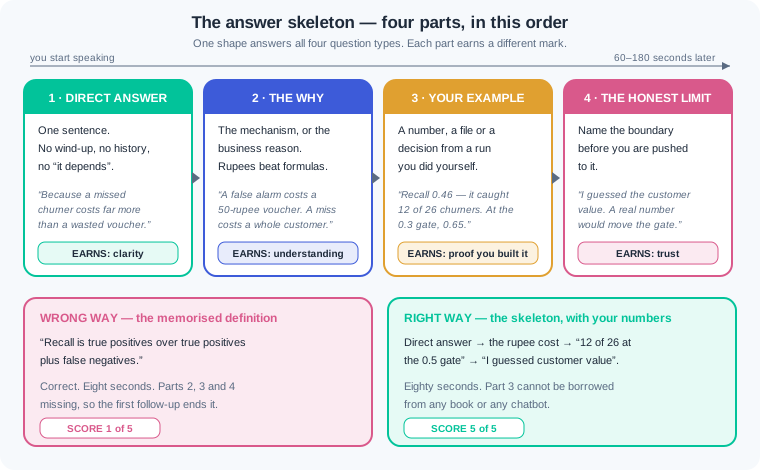
Each part earns something different, and that is why you keep all four. The one-sentence answer earns clarity. The why earns understanding. The example earns proof that you did the work. The honest limit earns trust, which is the hardest mark to win and the easiest to lose.
Here is the contrast this module exists for. The wrong way is a memorised definition, recited fast and correctly. It dies on the first follow-up, because nothing sits under it. The right way runs the skeleton and puts your own numbers in part three.
Say it like this. Recall is the share of real churners you caught. You chose it because one missed churner costs a whole customer. Your model caught 12 of 26 at the 0.5 gate. That figure holds on your seeded table, and a live table would move it.
Nobody knows everything, and interviewers know that. The professional move has two halves: say you do not know, then say how you would find out. Name the document, the experiment or the person you would go to. This scores better than a guess dressed up as an answer. Bluffing is the fastest rejection in the room, because the next question always finds the hole.
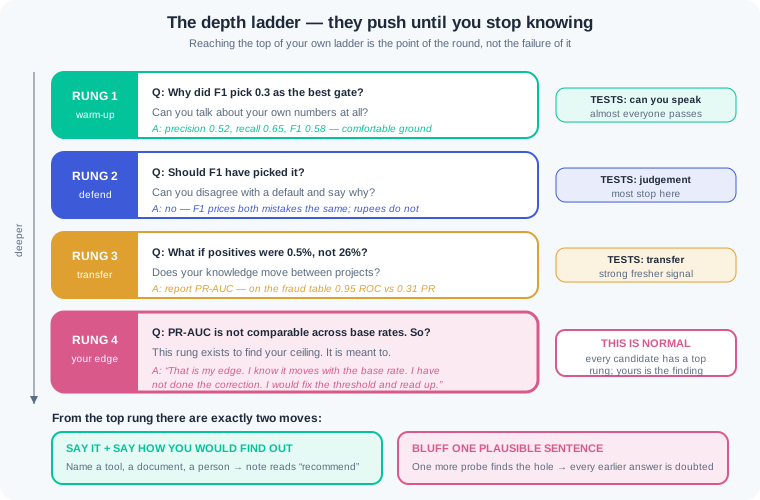
Good interviewers push until you stop knowing. They ask, you answer, they go one level deeper, and they repeat. This pattern is a depth ladder, and reaching your edge is the point of it. It is how they find your level, so it is not a failure. The figure shows one ladder and marks the rung where an honest edge belongs.
Your study material is already written, and you wrote half of it. Every module's recap block is five viva answers in compressed form. Every check block is five questions in the exact shapes above. The War Room entries are ready-made answers to "tell me about a time it broke". Mine those three, and 300 questions stop looking like a mountain.
Practise in pairs on a cadence, not in one long night. A pair viva costs an hour and gives you both a turn in the interviewer's chair. That chair teaches you more than ten solo answers do. Use spaced repetition: revisit a question one day later, then three days later, then a week later. Weak answers come back sooner, and strong ones drift further apart.
Grade every practice answer with the same rubric, or the practice slides off you. Five marks: one for each skeleton part, and one for how you handled the follow-up. Use a language model as your interviewer, never as your answer writer. Ask it to play the panel, push you with follow-ups, and grade you against the rubric. Memorised model output collapses in a viva the same way a memorised book line does.
Six transcripts, taken from the shape of real rounds. Read each one, then read the notes under it. The question in the first two blocks is the same question, answered two ways.
Transcript 1 — the memorised answer, and the two follow-ups that end it. The question is the one Girish met:
# TRANSCRIPT 1 - THE BAD ANSWER. Annotated line by line.

Q: You picked recall as the metric for the churn model. Why recall?

A: Recall is true positives divided by true positives plus false
   negatives. It measures how many of the actual positives the model
   found. It is used when false negatives are costly.
   [1] Correct. Also a definition, not an answer. No decision defended.
   [2] "It is used when..." - passive. Somebody else decided, not him.
   [3] Zero of his own numbers. Nothing here proves the project exists.

Q: Right. So what did choosing recall cost you?

A: Um. It... it improves the recall score.
   [4] The follow-up asked about a trade-off. He restated the metric.
   [5] This is the moment the interviewer learns there is nothing under
       the definition. Everything after this is a formality.

Q: Cost you in false alarms, I mean. How many extra?

A: I would have to check the notebook.
   [6] Fatal, because it is HIS notebook. Not knowing somebody else's
       number is fine. Not knowing your own number is not.

SCORE ON THE 5-MARK RUBRIC: direct answer 1, why 0, own example 0,
honest limit 0, follow-up handling 0. Total 1 of 5.
Line [1] is the trap most students walk into: the answer is correct and still fails. A definition answers "what is recall", and the interviewer asked "why recall". Line [4] is where the round ends, because the follow-up moved to trade-offs and the candidate had only one sentence in stock. Line [6] is the worst line in the block — the number lives in his own project, so "I would have to check" reads as "I did not do this". Notice that nothing here is a lie. This candidate is honest and unprepared, which is the common case, and it still scores 1 of 5.
Transcript 2 — the same question through the answer skeleton. Same student, same project, four weeks of the right practice:
# TRANSCRIPT 2 - THE GOOD ANSWER. Same question. Annotated line by line.

Q: You picked recall as the metric for the churn model. Why recall?

A: Because a missed churner costs far more than a wasted voucher.
   [1] PART 1 - direct answer, one sentence, first. The interviewer
       now knows where the answer is going and can relax.

   The two mistakes are not priced the same. A false alarm sends a
   50-rupee voucher to a customer who was staying. A miss loses a
   customer whose next 12 months were worth a few thousand rupees.
   So the cheap mistake is the one I chose to make more often.
   [2] PART 2 - the why, in rupees, not in formulas. This is the
       sentence that separates understanding from memorising.

   On my run the default 0.5 gate gave recall 0.46 - it caught 12 of
   26 real churners and missed 14. Moving the gate to 0.3 lifted
   recall to 0.65 and dropped precision from 0.67 to 0.52. Flags went
   from 18 to 33, so 15 more vouchers bought 5 more saved customers.
   [3] PART 3 - his own measured numbers, and the trade named in both
       directions. This is the part an LLM cannot write for him.

   The limit is that I priced the voucher and guessed the customer
   value. If the retention team gives me a real lifetime value I would
   redo the sweep, and the chosen gate could move.
   [4] PART 4 - the honest limit, stated before he is asked. This is
       the trust mark, and it also steers the next question.

SCORE ON THE 5-MARK RUBRIC: direct answer 1, why 1, own example 1,
honest limit 1, follow-up handling 1 (see transcript 3). Total 5 of 5.
Read the two blocks side by side and count the words: the good answer is roughly three times longer and took about eighty seconds. Part 2 does the work that the bad answer skipped, and it does it in rupees, because business words travel further than formulas. Part 3 is the part nobody can borrow — 12 of 26, 18 flags to 33 flags, 0.67 down to 0.52 — those numbers only exist if you ran the sweep. Part 4 volunteers the weakness, and volunteering it is what makes the rest believable. The whole answer is one skeleton, and the same skeleton would carry a question about leakage, batch size or PR-AUC.
Transcript 3 — the depth ladder, four rungs, and where the edge belongs. The interviewer keeps going until the candidate stops knowing. That is the design:
# TRANSCRIPT 3 - THE DEPTH LADDER. One topic, four rungs.

RUNG 1  Q: Why did the F1 score pick 0.3 as the best gate?
        A: F1 balances precision and recall equally, and at 0.3 the
           two were closest - 0.52 and 0.65, F1 0.58. It beat 0.55 at
           the 0.5 gate and 0.44 at 0.7.
        -> Fine. Comfortable ground. Rung 1 is a warm-up.

RUNG 2  Q: Should F1 have picked it?
        A: No. F1 assumes both mistakes cost the same, and in this
           project they do not. I let rupees pick the gate instead,
           and rupees chose a lower cutoff than F1 did.
        -> Now he is arguing against a metric. This is the rung most
           candidates never reach, and it is worth real marks.

RUNG 3  Q: Your positives are 26 percent here. What if churn were
           0.5 percent, like the fraud table?
        A: Then precision collapses at any useful recall, and I would
           report PR-AUC instead of ROC-AUC. On our fraud table
           ROC-AUC read 0.95 while PR-AUC read 0.31, and the 0.5 gate
           caught 5 frauds out of 45.
        -> He carried a number across two projects. Strong signal.

RUNG 4  Q: PR-AUC is not comparable across datasets with different
           base rates. How would you compare two models on two
           different months of data?
        A: That is my edge. I know PR-AUC moves with the base rate,
           so comparing raw numbers across months would mislead. I
           have not done the correction myself. I would fix the
           decision threshold, compare cost in rupees per thousand
           customers, and read up on base-rate normalisation before
           I claimed anything stronger.
        -> THE EDGE, handled well. Named it, showed the boundary of
           what he knows, gave a concrete route forward. Full marks
           on this rung. The ladder was supposed to end here.

INTERVIEWER'S NOTE: "Strong on metrics. Found his ceiling at rung 4,
which is above the bar for a fresher. Recommend."
Four rungs is a normal ladder, and reaching the top of yours is the goal, not the danger. Rung 1 checks that you can talk. Rung 2 checks that you can disagree with a default. Rung 3 checks whether your knowledge moves between projects. Rung 4 is designed to find your ceiling, and the note at the bottom is the proof: the candidate was recommended in the same breath as being stopped. Compare that with what a bluff would have produced at rung 4 — one invented sentence, one more probe, and a different note.
Transcript 4 — an artefact on the screen, read out loud. The interviewer shares one block and says three words: "read this to me":
# TRANSCRIPT 4 - INTERPRET THE ARTEFACT.

THE ARTEFACT ON SCREEN:

              precision    recall  f1-score   support
      stayed       0.83      0.92      0.87        74
     churned       0.67      0.46      0.55        26
    accuracy                           0.80       100

Q: Read this to me. What is your headline?

A: The headline is that 0.80 accuracy is hiding a weak model on the
   class we care about.
   [1] PART 1 first, again. Not "accuracy is 0.80" - that is reading
       aloud, not interpreting.

   The support column is the giveaway: 74 stayers against 26
   churners. A model that flagged nobody would already score 0.74,
   so 0.80 is six points above doing nothing.
   [2] He computed the baseline from the artefact itself, unasked.

   The churned row is the real story. Recall 0.46 means it caught 12
   of the 26. Precision 0.67 means of its 18 flags, 12 were right and
   6 were false alarms. In business words: it misses more than half
   the customers walking out.
   [3] He converted every ratio back into counts. Counts are what a
       manager can act on.

   What I cannot tell from this table is the threshold, or whether
   these are test rows or training rows. Both change the reading, so
   I would ask before I trusted it.
   [4] PART 4 - names what the artefact does NOT show. This is the
       line that separates a reader from a reciter.
The four-part skeleton works unchanged on artefacts, and part 1 is where most students lose the mark by narrating numbers instead of naming the story. Line [2] is the move to steal: the support column gives you the majority-class baseline for free, and 74 out of 100 is a number you can compute aloud in three seconds. Line [3] turns 0.46 into "12 of 26" and 0.67 into "12 of 18 flags", because ratios hide the size of the problem and counts do not. Line [4] is a small, high-value habit — every artefact has a missing column, and naming it proves you are reading rather than reciting. This is WR-058 and WR-062 wearing interview clothes.
Transcript 5 — the "I do not know" protocol, used twice. Once badly, once professionally, on the same question:
# TRANSCRIPT 5 - THE "I DO NOT KNOW" PROTOCOL.

Q: How would you serve this churn model to 2,000 kirana stores at
   once, with a 200-millisecond budget?

--- VERSION A: THE BLUFF (this is WR-158) ---
A: I would use Kubernetes with auto-scaling and a load balancer, and
   cache the predictions in Redis for low latency.
   [1] Fluent, plausible, and built from words he has read.

Q: What would you cache - the features or the predictions? And what
   expiry?
A: The... predictions. With a standard expiry.
   [2] "Standard" is the bluffer's word. There is no standard expiry.

Q: A stale prediction on a store that churned yesterday - is that a
   problem for you?
A: I suppose it could be.
   [3] Two probes, and the answer is gone. Now everything he said
       earlier is in doubt, including the parts that were true.

--- VERSION B: THE PROTOCOL ---
A: I have not served a model at that scale, so I will tell you what I
   do know and where my line is.
   [1] Says it in the first sentence. No stalling, no fog.

   I have served this model with FastAPI on one machine and measured
   the latency, so I know the model itself answers in single-digit
   milliseconds and that batching helps.
   [2] Gives the ground he DOES hold. Always do this.

   At 2,000 stores I would expect the load, the cold start and the
   feature lookup to dominate, not the model.
   [3] Reasons from what he knows to what he does not. This is worth
       more than the answer itself.

   To close the gap I would load-test with Locust against one
   instance, read the AWS scaling docs for the service we pick, and
   ask whoever owns the current serving stack what breaks first.
   [4] THE SECOND HALF: how he would find out. Named a tool, a
       document and a person. Concrete beats humble.

INTERVIEWER'S NOTE on B: "Honest about scope. Reasoned to the edge
of it. I would trust his estimates."
Version A is not a knowledge failure; it is a judgement failure, and it costs more than the missing knowledge would have. The two probes in lines [2] and [3] are cheap for the interviewer and impossible for a bluffer, which is exactly why they get asked. Version B follows the two-half rule: say it, then say how you would find out. The half everyone forgets is the second one — "I do not know" on its own is honest and empty, while a named tool, a named document and a named person turn it into a plan. Note the interviewer's word in the closing note: trust. That is the mark you were playing for.
Transcript 6 — the rubric, applied to a real answer. This is how you grade your own recordings and your partner's answers:
# TRANSCRIPT 6 - SELF-GRADING WITH THE 5-MARK RUBRIC.

THE RUBRIC (1 mark each, 5 total):
  1. DIRECT   - answered in the first sentence, no wind-up
  2. WHY      - gave the mechanism or the business reason
  3. EXAMPLE  - used a number or a decision from their OWN work
  4. LIMIT    - named a boundary before being pushed to it
  5. FOLLOW-UP- held up under one probe, or reached the edge honestly

THE ANSWER BEING GRADED:

Q: What happens if you train the scaler before splitting the data?
A: You get leakage. The scaler sees the test rows, so the mean and
   the standard deviation it learns include information from rows the
   model is supposed to have never met. Your test score comes out a
   little too high. In my churn pipeline I put StandardScaler inside
   the Pipeline so it refits inside every fold.

GRADING, MARK BY MARK:
  1. DIRECT   1/1  "You get leakage." First sentence. Done.
  2. WHY      1/1  Named the mechanism: mean and std carry test info.
  3. EXAMPLE  0/1  Says WHAT he did, gives no NUMBER. How much too
                   high? He never measured it, so this is a claim.
  4. LIMIT    0/1  No boundary named. Preprocessing leakage is usually
                   small; target leakage is huge. He does not separate
                   them, so he cannot say how much this one mattered.
  5. FOLLOW-UP -   Not tested in this clip.
  TOTAL: 2 of 4 available.

THE REWRITE HE OWES HIMSELF (parts 3 and 4 only):

   I tested it on the churn table: fitting the scaler before the split
   moved my test score by about a point, which is small. The one that
   actually bit me was target leakage in 1.7, where a support-ticket
   flag pushed the score to 0.99 overnight. So the honest limit is
   that preprocessing leakage is a discipline problem, not usually a
   score disaster - target leakage is the one that ends projects.
Grade in this order and the marks stop being subjective. Marks 1 and 2 are nearly always easy to award or refuse, because either the first sentence answered the question or it did not. Mark 3 is where most self-grading goes soft: "I used a Pipeline" is a claim, and "it moved my score by about a point" is evidence, and only the second earns the mark. Mark 4 catches over-claiming, which is the failure mode of a student who has read more than they have run. Write the rewrite every time you refuse a mark, because the rewrite is the practice — the score is only the label on it.
Work in a folder called viva-prep with four files that grow across two weeks: answers.md for your written skeletons, scores.csv for every graded attempt, edges.md for the questions where you reached your honest edge, and schedule.md for your spaced-repetition dates. Grade with the five-mark rubric from transcript 6, every single time, including when you are grading yourself and would rather not.
Mine the spine, then write 20 skeleton answers in your own words. Open ten modules you have finished, spread across Phase 0, 1 and 2. From each one, take the recap block and the check block, and pull out two questions an interviewer could plausibly ask about work you actually did. Now write all twenty answers in answers.md using the four-part skeleton, with the four parts labelled so you can see the shape. Part three must carry a real number, a real file name or a real decision from your own runs — if you cannot supply one for a question, mark that answer NO EVIDENCE in red and keep it in the file, because that list is your real revision plan. Finish by reading five of them out loud with a timer and writing the spoken length beside each. Check: answers.md holds twenty answers with all four parts labelled in each; at least sixteen have a real number, file name or decision in part three; every NO EVIDENCE answer is listed separately with the one experiment that would fix it; five answers have a measured spoken time recorded, and you state how many landed inside 60 to 180 seconds; and you name the one module whose recap gave you the least usable material, with a sentence on why.
The pair viva: two students, twenty questions, one rubric. Pair with a classmate and open the module's viva bank. Each of you picks ten questions for the other, drawn from at least four different topics and including at least two of each shape — explain, why-choice, what-if and interpret-artefact. Run it strictly: the interviewer asks, starts a timer, does not help, and after the answer asks at least one follow-up from the bank's follow_ups list before moving on. Score every answer on the five marks as it happens, and write one sentence of evidence for every mark you refuse. Then swap chairs and repeat, and finish with ten minutes where each of you tells the other the single habit that cost the most marks. Check: scores.csv holds twenty rows with five marks each and a refusal reason on every zero; the ten questions you set covered four or more topics and all four shapes, listed by id; you recorded which of the two chairs taught you more and why, in three sentences; every question where either of you hit an honest edge is copied into edges.md with the exact words used; and you both name one red flag from the bank that you actually produced, quoting your own sentence.
Working alone? Use the solo substitute defined in project P1: pick the twenty questions yourself, record your answers cold with the timer running, then grade the recording against the five-mark rubric as strictly as a partner would — refusal reasons and all.
Record five answers, grade yourself, then re-answer the two worst. Pick five bank questions you have not rehearsed, one of them an interpret-artefact question. Record audio or video of yourself answering each with no notes and no pauses to think in silence. Play each recording back with the rubric open and grade it honestly, writing the timestamp of the exact moment you lost each mark. Rank the five by score, take the two lowest, and diagnose them: was the missing mark knowledge, evidence, or structure? Rewrite only the parts that failed, re-record those two answers, and grade them again. Check: five recordings exist with their lengths noted and all five graded on the five marks; every lost mark has a timestamp and one sentence naming what should have been said instead; the two weakest are diagnosed as knowledge, evidence or structure, with your reasoning; both re-recordings exist and are graded, with the before and after totals side by side; and you state in one sentence whether the improvement came from knowing more or from saying it better, since those need different fixes.
Climb four ladders, use the protocol on purpose, and build the fortnight schedule. Choose four topics you believe are strong: one metric topic, one leakage or validation topic, one deep-learning training topic, and one from your own project. For each, have your partner or a language model act as interviewer and push you down a four-rung depth ladder — each rung must go one level deeper than your last answer, never sideways. Your goal is to reach your honest edge on all four and to use the two-half protocol there in full: say it, then name a tool, a document and a person. Log every edge in edges.md with the rung number and your exact words. Finish by building schedule.md: every question you scored 3 or less returns tomorrow, every 4 returns in three days, every 5 returns in a week, with dates written down. Check: four ladders are logged with all four rungs and the question asked at each; you reached an honest edge on at least three, with your exact words and a named tool, document and person in each; you mark any ladder where you bluffed instead, quoting the invented sentence and what you should have said; schedule.md holds dated return slots for every question from all four exercises, sorted by date; and you state your predicted weakest topic for next week and the one measurement that will prove you right or wrong.
Three viva failures, all of them common and all of them fixable in a fortnight. Each has a War Room entry with the full diagnosis path:
- WR-157 — the memorised definition that collapsed. A candidate recited a correct textbook line, and the first follow-up found nothing underneath it; the fix is the four-part skeleton with the own-example rule that makes part three impossible to borrow.
- WR-158 — the bluff that ended the interview. An invented answer about a tool the candidate had never used survived exactly one probe; the fix is the two-half protocol — say you do not know, then name the tool, the document and the person you would go to.
- WR-159 — the project they could not defend. A resume line about a project the candidate could not explain for ten minutes turned every other line on the page into a doubt; the fix is the rule that you never list what you cannot defend under questioning.
The theory round is a conversation whose only question is whether you understand what you built. Four question shapes cover it, and one answer skeleton handles all four: the direct answer, the why, an example from your own work, and the honest limit. Part three is the part nobody can write for you, so every practice answer must carry a real number or a real decision from your own runs. When you reach the end of what you know, say so and then say how you would find out, because bluffing loses the round faster than not knowing does. Prepare from the spine you already finished, practise in pairs on a spaced schedule, and grade every attempt on the same five marks.
- IT services campus hiring in India runs this round at volume, often as the second technical interview. The panel has fifteen minutes and your resume, so the depth ladder is their fastest tool for sorting a large batch of freshers.
- Analytics teams at banks and NBFCs ask the artefact question almost every time. Reading a confusion matrix or a drift report out loud is the daily work, so the round is a work sample rather than a quiz.
- Product and GCC teams use the honest-limit habit as a hiring signal. A fresher who states the boundary of a claim is cheap to supervise, and one who over-claims about a UPI or kirana pipeline is expensive to correct later.
Answer these aloud before opening the gate assessment. Each question names its kind.
type=interpretation— A candidate is asked why they chose recall and replies with the formula, then says "it is used when false negatives are costly". Grade that answer on the five marks, award or refuse each one with a reason, and name the single sentence you would add to move it from 1 of 5 to 3 of 5.type=scenario-judgement— At rung four of a depth ladder you meet a term you have never heard. You have a plausible guess. Give your ruling on what you say, the exact first sentence you use, and justify it against what the interviewer is actually measuring at that rung.type=debug— A student's practice answers all score 4 of 5, with part three always failing. Diagnose the underlying cause from that pattern alone, and give the one change to their preparation that fixes it.type=trade-off— Compare preparing by re-reading the module notes against preparing by recording and self-grading five answers. Give one concrete gain and one concrete cost of each, then say which you would run in the last 48 hours before a round, and why.type=output-prediction— A candidate says "I would cache the predictions with a standard expiry" about a system they have never built. Predict the interviewer's next two questions and what the candidate's answers to them will sound like, then state what the note at the end of the round will say.
Explain to a friend from a non-technical degree why an interviewer keeps asking harder and harder questions until you cannot answer, and why that is not a sign you failed. Use an everyday comparison, such as a shopkeeper working out how much a new helper already knows about the stock. Then tell your friend the four parts of a good answer, in order, and the two things you say when you have run out of knowledge. Use at most 4 sentences and no word your friend would need to look up. If your friend can repeat the four parts and both halves of the "I do not know" move, you own this module.